Growing Bodies, Changing Injuries
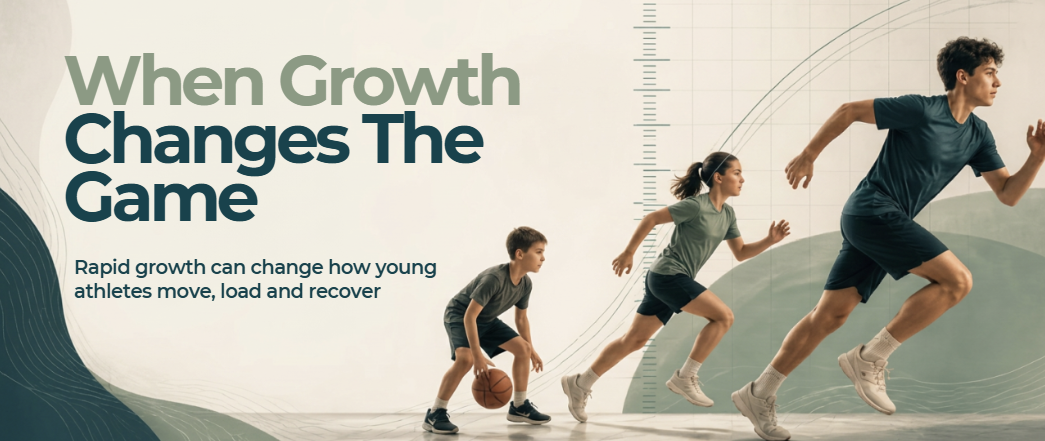
Why Growth Spurts Matter in Young Athletes
One month their shoes fit. A few months later their trousers are too short, their feet seem enormous, and they may suddenly look taller and leaner.
For parents, a growth spurt is often something noticed in photographs, clothing and appetite. For a young athlete, however, rapid growth also means that the body being asked to run, jump, land, kick, throw and change direction is physically changing while it performs those tasks.
Research increasingly suggests that this matters.
Growth-related injuries tend to peak around the adolescent growth spurt, and more rapid increases in height and lower-limb length have been associated with greater injury incidence and injury burden in young athletes. Importantly, however, growth does not simply cause injury. Training exposure, previous injury, strength, recovery, sport and biological maturation all interact.
The age on the birthday cake doesn’t tell the whole story
Children of exactly the same chronological age can be at very different stages of physical maturation.
One important landmark is peak height velocity (PHV)—the period during which height is increasing at its fastest rate.
Girls generally reach this stage earlier than boys. Research in female athletes places average PHV around the early adolescent years, although there is considerable variation between individuals.
This variation is important. Two children of exactly the same age may be at very different stages of skeletal and physical maturation.
Clinically, parents may notice rapid changes in height, shoe size and clothing length before thinking of their child as being “in a growth spurt.”
This helps explain something that parents, coaches and clinicians commonly notice: injury patterns don’t necessarily occur at identical ages in girls and boys.
A girl experiencing rapid growth around 11–12 and a boy experiencing it later in adolescence may be going through comparable biological changes despite being several years apart chronologically.
That also fits reasonably well with the clinical pattern of seeing more problems around 12 in girls and around 14–15 in boys.
But these shouldn’t become rigid “injury ages.”
A late-maturing 15-year-old boy may be changing rapidly while another 15-year-old has already passed through his fastest growth. Similarly, two 12-year-old girls may be at very different stages of maturation.
Age gives us context. Growth gives us another piece of the picture.
What is actually changing?
A growth spurt is much more than simply becoming taller.
1. The skeleton is still developing
Children and adolescents have structures that adults no longer have in the same form.
The growth plate (physis) is an area of developing tissue near the ends of long bones. There are also apophyses—developing attachment regions where tendons connect to bone.
These areas create injury patterns that are characteristic of growing athletes and may be particularly susceptible to repetitive loading.
This is one reason a young athlete’s pain should not automatically be interpreted using an adult injury model.
2. Different parts of the body don’t necessarily develop simultaneously
Growth is not perfectly synchronised.
Different skeletal regions mature at different times, and growth-related injuries appear to show a fascinating progression.
Research describes a distal-to-proximal pattern: heel-related apophyseal problems such as Sever’s disease tend to occur earlier, followed by knee conditions such as Osgood-Schlatter and Sinding-Larsen-Johansson syndrome, while pelvic apophyseal problems tend to occur later in adolescence.
In other words, the type and location of injury can change as the child moves through maturation.
3. The body’s levers are changing
Imagine learning to control a tennis racket and then gradually lengthening its handle.
The forces and control requirements change.
Something similar happens during growth.
As the femur and tibia lengthen, limb leverage changes. The centre of mass changes as body proportions change. Muscle must control a body that may suddenly be taller and heavier.
In adolescent girls specifically, research examining landing mechanics has found maturation-related changes in several biomechanical variables associated with ACL injury mechanisms.
That doesn’t mean puberty inevitably produces poor movement or an ACL injury.
It means movement demands change as the body changes.
What about the “awkward teenager”?
Parents sometimes describe a previously coordinated child suddenly looking a little awkward during a growth spurt.
There may be some biological basis for this observation.
Rapid and asynchronous changes in skeletal, muscular and ligamentous structures, together with changes in perceptual-motor development, have been associated with temporary alterations in mobility and motor coordination.
But this needs careful wording.
Not every teenager becomes uncoordinated during rapid growth, and researchers don’t support treating “adolescent awkwardness” as inevitable.
A better way to think about it is that the nervous system is continually controlling a body whose dimensions, leverage and mass are changing.
For an athlete performing high-speed or technically demanding movements, those changes may matter.
Growth can expose an existing predisposition
A growth spurt does not necessarily create the factor that contributes to an injury.
A child may have managed very well for years with a particular combination of joint mobility, asymmetry, alignment or movement strategy.
Then they grow rapidly.
Their legs lengthen. Their leverage changes. Their body mass increases. Training becomes harder. Sporting speed increases.
Something that previously required relatively little control may suddenly require considerably more.
Growth and increased sporting load may therefore expose a previously well-compensated vulnerability rather than creating an entirely new problem.
This is why assessment of the growing athlete can consider more than simply the painful structure.
Growth and maturity stage, training load, previous injury, joint mobility, strength, balance, alignment, movement quality and the specific demands of the athlete’s sport may all contribute pieces of the puzzle.
Hypermobility: when greater movement also requires greater control
Some children and adolescents naturally have a greater range of joint movement than others. This is known as joint hypermobility.
Hypermobility itself is not necessarily a problem. Many hypermobile children are completely asymptomatic, and greater flexibility can even be advantageous in sports such as gymnastics and dance.
However, greater available movement also means that the muscular and neuromuscular systems may have to provide more active control and stability, particularly during running, landing, cutting and other high-load sporting movements.
Research examining hypermobility and sporting injury is not completely consistent across every sport and injury type. However, a systematic review and meta-analysis found an increased risk of knee injury among hypermobile participants in contact sports, while the same association was not demonstrated for ankle injury.
This becomes particularly relevant during adolescence because the athlete may simultaneously be dealing with rapid growth, changing leverage, increasing body mass, greater training loads and greater joint mobility.
For a hypermobile young athlete, simply stretching more may therefore not always be the priority.
The emphasis may instead need to include:
strength + joint control + proprioception + balance + landing control + deceleration + sport-specific stability.
The goal is not to make a flexible child “stiff.”
It is to help them develop control throughout the range of movement they already have.
Does posture and alignment matter?
Posture also deserves consideration, but it needs some nuance.
There is no single “correct posture” that prevents sporting injury, and seeing a postural difference does not mean that a child is destined to become injured.
However, alignment and movement strategy can influence how forces are distributed through the body during a particular task.
Lower-limb alignment and dynamic movement patterns involving the trunk, hip, knee and foot can influence loading during running, jumping and landing. In young athletes, these patterns may become particularly relevant as body proportions and strength change during maturation.
This is why assessment should look beyond a static photograph of how a child stands.
A child may appear relatively symmetrical while standing but demonstrate a very different strategy when asked to:
stand on one leg,
squat,
run,
jump and land,
decelerate,
or change direction.
Conversely, a visible postural variation at rest does not automatically mean that the child’s movement is dysfunctional or that an injury will occur.
Static posture is only part of the picture. What happens under load often tells us more.
Different growth stages, different injuries
This is where understanding growth becomes particularly useful.
Heel pain — Sever’s disease
Calcaneal apophysitis, commonly called Sever’s disease, is one of the characteristic growth-related conditions of younger athletes.
Running and jumping repeatedly load the developing heel through the Achilles tendon and plantar structures.
A child may complain that the heel hurts during or after sport and may begin limping or altering the way they run.
It tends to appear relatively early in the sequence of growth-related apophyseal problems.
Knee pain — Osgood-Schlatter disease
As maturation progresses, the knee becomes another common site.
Osgood-Schlatter disease involves the tibial tubercle, where the patellar tendon attaches below the knee.
Running, jumping and kicking repeatedly load this developing attachment.
Children often describe pain directly over the bump below the kneecap, particularly with sport.
Pain at the bottom of the kneecap — Sinding-Larsen-Johansson syndrome
Less familiar to many parents is Sinding-Larsen-Johansson syndrome.
Here, repetitive loading affects the developing attachment at the lower pole of the patella.
It can therefore look superficially similar to other causes of anterior knee pain, but the anatomical location and developmental stage matter.
Hip and pelvic pain — apophyseal injuries
Later in maturation, powerful muscles acting around the pelvis can repeatedly load developing attachment sites.
Sprinters, footballers, gymnasts and athletes involved in explosive kicking or acceleration may be particularly exposed.
Sometimes the problem develops gradually as an apophysitis.
In other cases, a forceful muscular contraction can produce an apophyseal avulsion injury, in which the developing attachment is pulled away from the bone.
That is very different from simply having a “tight muscle.”
And then there is the growing spine
The spine deserves particular attention in young athletes.
Persistent lower-back pain in a child or teenager should not automatically be dismissed as muscular—particularly in sports involving repeated extension, rotation or substantial spinal loading.
Spondylolysis is a stress injury involving the pars interarticularis of a vertebra, most commonly in the lower lumbar spine.
If one vertebra subsequently slips relative to the one beneath it, this is termed spondylolisthesis.
Sports involving repeated extension and rotation can increase loading of this region.
This doesn’t mean every teenager with back pain requires imaging. It means that persistent, recurrent or activity-specific back pain deserves an appropriate clinical assessment rather than simply being labelled “growing pains.”
We will explore spondylolysis and spondylolisthesis in more detail in the next article.
Bone is growing too
Height can increase rapidly during adolescence, but skeletal development involves more than length.
Changes in bone size and mineralisation do not occur in perfect synchrony, and the adolescent growth period has been proposed as a period during which rapidly developing bone may be relatively vulnerable to repetitive loading.
For athletes performing repetitive high-load activities, recovery therefore matters.
Bone stress injuries often develop not because of one dramatic incident but because repeated loading exceeds the tissue’s capacity to recover and adapt.
What about sprains and other sporting injuries?
Not every injury during adolescence is specifically a growth-related condition.
Young athletes also experience ankle sprains, knee injuries, muscle strains and other traumatic or overuse injuries associated with their sport.
Here, growth may act less as a direct cause and more as part of the athlete’s changing physical environment.
Longer limbs, changing leverage, increasing speed and strength, previous injury, joint mobility and increasingly demanding competition can all interact.
Previous injury is particularly important. An athlete returning to sport may be pain-free but still have deficits in strength, balance, proprioception or movement control.
This is one reason rehabilitation should consider not only whether something still hurts, but whether the athlete has regained the capacity required by their sport.
Girls deserve a little extra attention
The female athlete deserves a separate discussion rather than simply applying research conducted in boys.
Historically, much youth-sport research has disproportionately studied males.
Evidence specifically connecting biological maturation with actual sporting injury in young female athletes remains more limited. However, maturation-related changes in lower-limb biomechanics have been demonstrated.
One area where this becomes particularly important is the knee.
After puberty, female athletes have a substantially higher ACL injury risk than males participating in comparable pivoting sports. Anatomical, hormonal, strength, neuromuscular and biomechanical factors have all been investigated; there is unlikely to be one single explanation.
Research examining landing mechanics has also identified maturation-related changes in knee biomechanics in female athletes.
This does not mean puberty causes ACL injury.
It does mean that adolescence is an important period to continue developing strength, landing control and neuromuscular capacity, rather than waiting until an injury occurs.
Growth + sport + load
Growth is only one part of the equation.
Consider a 14-year-old who has:
grown rapidly,
moved into a more competitive team,
increased training from twice to four times per week,
started additional school sport,
and begun weekend competitions.
If pain develops, blaming the growth spurt alone misses half the story.
The athlete’s body has changed at exactly the same time that its workload has increased.
That combination is much more clinically meaningful.
Research investigating growth and maturation in elite youth athletes similarly cautions against treating maturation as an isolated predictor. Injury associations vary considerably depending on the type of injury, growth rate, maturity status and sporting environment.
Can balance, coordination and agility training help?
This is where understanding the changing body becomes practical.
We cannot stop the growth spurt, but we can continue developing the athlete’s capacity to control the body as it changes.
Balance exercises challenge the athlete to maintain control of their centre of mass over their base of support.
This can progress from simple single-leg control to dynamic tasks involving reaching, catching, landing or reacting to movement.
Agility adds another layer.
The athlete has to accelerate, decelerate, change direction and reorganise the body quickly.
Jumping and landing exercises teach athletes not only to produce force but also to absorb and control it.
And strength training develops the physical capacity required to manage those forces.
Research supports multicomponent neuromuscular injury-prevention programmes in young athletes. These commonly combine strength, balance, jumping and landing, agility and movement-control exercises and have been associated with reductions in lower-extremity sporting injuries.
This is particularly important in adolescent female athletes, where neuromuscular programmes form an important component of ACL injury-prevention strategies.
Balance is useful, but balance alone isn’t the answer
Standing on one leg or using a wobble board may improve aspects of balance and proprioceptive control, but injury prevention should not be reduced to one exercise.
A growing athlete needs the ability to control their body when they are running, landing, cutting, accelerating, decelerating and reacting.
A useful progression might look like:
Single-leg control
↓
Dynamic balance
↓
Landing control
↓
Multidirectional movement
↓
Acceleration and deceleration
↓
Change of direction
↓
Reactive agility
Strength belongs alongside all of these.
This progression becomes especially relevant for athletes with increased joint mobility or those whose movement strategies appear to have changed during rapid growth.
Importantly, this does not mean that balance or agility exercises specifically prevent conditions such as Sever’s disease, Osgood-Schlatter disease or spondylolysis.
The stronger evidence is for multicomponent neuromuscular programmes reducing broader lower-extremity injury risk, alongside sensible training load, recovery and sport-specific preparation.
The goal is to help strength, coordination and movement capacity keep developing alongside the changing body.
A simple growth-spurt check for parents
You don’t need sophisticated equipment to notice that your child is changing rapidly.
Ask yourself:
Has their height changed noticeably over the last few months?
Have trousers suddenly become short?
Has shoe size changed?
Has their training volume recently increased?
Are they complaining repeatedly about the same specific area?
Does pain disappear with rest but return every time they train?
Have you noticed limping or a change in running?
Are they struggling with movements that were previously comfortable?
Does jumping or landing look different?
Do they struggle to control a single-leg position or landing?
Is there a noticeable difference between sides?
If they are very flexible, can they control that range during movement?
Does their movement or alignment change as they become tired?
Has performance unexpectedly declined?
Are they recovering adequately between training sessions?
None of these individually diagnoses an injury or predicts that one will occur.
Together, however, they provide useful context.
“It’s just growing pains”
This phrase deserves caution.
Classic benign growing pains generally have a characteristic presentation and should not become a blanket explanation for musculoskeletal pain in active children.
Focal pain in one anatomical area, pain reproducibly triggered by sport, persistent tenderness, swelling, limping or progressive symptoms should not simply be attributed to growth.
Growth may be part of the context.
It isn’t automatically the diagnosis.
When should a young athlete be assessed?
Pain that repeatedly returns with activity deserves attention, particularly during rapid growth.
Assessment becomes more important when there is persistent focal pain, limping, inability to participate normally, progressive loss of function, significant trauma or symptoms that fail to improve despite appropriate rest and load modification.
More urgent medical assessment is appropriate for concerning features such as inability to weight-bear, significant neurological symptoms, systemic illness, unexplained fever, severe night pain or other unusual or progressive symptoms.
The purpose isn’t to medicalise every ache.
It is to recognise when something no longer behaves like a temporary response to exercise.
Can injuries during growth be prevented?
Not every sporting injury is preventable.
But a growth spurt is an excellent time to reconsider what the athlete’s body currently needs.
Strength training that is appropriately designed and supervised for age and development can be beneficial. Neuromuscular programmes incorporating strength, landing technique, balance, agility and plyometric components can also contribute to injury prevention.
For athletes with hypermobility, developing active control through available range may be particularly important.
For athletes demonstrating postural or alignment differences, the question should not simply be how they look while standing. It should include how effectively they control movement under sporting load.
Training progression matters too.
A young athlete doesn’t necessarily need to stop training because they are growing. But sudden increases in volume and intensity deserve attention, particularly when accompanied by new persistent symptoms.
Sleep, adequate nutrition and recovery remain fundamental parts of athletic development.
The athlete you assessed six months ago may have a different body today
This may be the most important concept.
A young athlete isn’t physically static between annual check-ups.
Their limb length, height, mass, strength, leverage, skeletal maturity and movement strategies can all change substantially during adolescence.
That is why a movement pattern that was comfortable six months ago may feel different now.
And it is why persistent pain during rapid growth deserves to be considered within the context of development, not merely the injured body part.
Assessment of the growing athlete can therefore ask more than simply:
Where does it hurt?
It can also ask:
How much have they grown?
Has their training changed?
Have they been injured before?
Are they particularly mobile or hypermobile?
How well do they control that mobility?
How do they balance, land, decelerate and change direction?
Does their alignment or movement strategy change under load or fatigue?
These questions do not predict injury with certainty.
They help us understand the athlete within the context of their changing body.
The bigger picture
Growth is healthy.
Sport is healthy.
Neither should be feared.
But the intersection between rapid growth and sporting load deserves attention.
Current research supports an association between growth, maturation and injury, particularly for growth-related injuries, while also showing that the relationship is complex and differs between injuries and athletes.
Girls generally pass through their fastest growth period earlier than boys. Different growth-related injuries also tend to emerge at different stages as maturation progresses.
Individual characteristics matter too. Hypermobility, previous injury, alignment, strength and movement strategies may alter how an athlete manages the changing demands placed on their body.
No single posture, age or physical characteristic determines whether a child will become injured.
Instead, we need to look at the whole developing athlete.
We cannot prevent a child from growing, nor should we try.
The goal is to help strength, coordination and movement capacity develop alongside the changing body.
So instead of waiting for an arbitrary birthday to decide when an athlete becomes vulnerable:
Watch their training.
Watch persistent pain.
Watch how they move.
Watch how they control their changing body.
And above all:
Don’t just watch the age. Watch the growth.
References
Donath, L., Rössler, R. & Faude, O. (2017). Effects of multimodal injury prevention programmes on neuromuscular performance in youth sport: a systematic review and meta-analysis of randomised controlled trials. Frontiers in Physiology, 8, 791.
Emery, C.A., Roy, T.O., Whittaker, J.L., Nettel-Aguirre, A. & van Mechelen, W. (2015). Neuromuscular training injury prevention strategies in youth sport: a systematic review and meta-analysis. British Journal of Sports Medicine, 49(13), 865–870.
Olivier, F., Olivier, B., Swart, J.J.W., Hohlfeld, A.S.-J. & MacMillan, C. (2026). Effect of neuromuscular training strategies on injury rates in adolescent males playing sport: a systematic review and meta-analysis. Physical Therapy in Sport, 79, 101904.
Pacey, V., Nicholson, L.L., Adams, R.D., Munn, J. & Munns, C.F. (2010). Generalized joint hypermobility and risk of lower limb joint injury during sport: a systematic review with meta-analysis. American Journal of Sports Medicine, 38(7), 1487–1497.
Parry, G.N., Williams, S., McKay, C.D., Johnson, D.J., Bergeron, M.F. & Cumming, S.P. (2024). Associations between growth, maturation and injury in youth athletes engaged in elite pathways: a scoping review. British Journal of Sports Medicine.
Ramachandran, A.K., Pedley, J.S., Moeskops, S., Oliver, J.L., Myer, G.D. & Lloyd, R.S. (2023). The efficacy of neuromuscular training, with minimal or no equipment, on performance of youth athletes: a systematic review with meta-analysis. Physical Therapy in Sport, 64, 104–116.
Ramachandran, A.K., et al. (2024). Changes in lower limb biomechanics across various stages of maturation and implications for ACL injury risk in female athletes: a systematic review. Sports Medicine, 54, 1851–1876.
This article is intended for general educational purposes and does not replace individual medical assessment, diagnosis or treatment. Persistent, worsening or concerning pain in a child or adolescent should be assessed by an appropriately qualified healthcare professional.