Primitive Reflexes: Understanding Your Baby’s Early Movement Development

Primitive reflexes can sound technical, but they’re simply your baby’s built-in “starter system” for early survival and movement.
If you’ve ever noticed a newborn grasp your finger tightly or startle at a sudden sound, you’ve seen these reflexes in action.
This article explains what primitive reflexes are, why they matter for early development, what it can mean if reflex patterns seem to linger, and when it may be worth seeking an assessment—always with a whole-child, medically cautious lens.
Every Baby Is Born With Reflexes
From the first moments of life, babies rely on automatic movement patterns that are driven by the brain and nervous system. These early reflexes help with feeding, comfort, protection, and the beginnings of posture and coordination.
As your baby grows, development usually moves from “automatic” to “intentional”: reflex-based movements gradually give way to more controlled, purposeful skills like reaching, rolling, sitting, and walking.
Reassuring note — Development is not a straight line. Babies vary widely in how and when they show skills, and a single observation rarely tells the full story.
What Are Primitive Reflexes?
Primitive reflexes are automatic responses to specific sensations—like touch, head position, or sudden noise. They’re present in infancy because the nervous system is still developing the “higher-level” control needed for smooth, voluntary movement.
You can think of primitive reflexes as the brain’s early movement templates. Over time, as the brain matures and a child gains strength and stability, these reflexes typically become less dominant and are replaced by more flexible, intentional movement strategies.
Examples of common primitive reflexes:
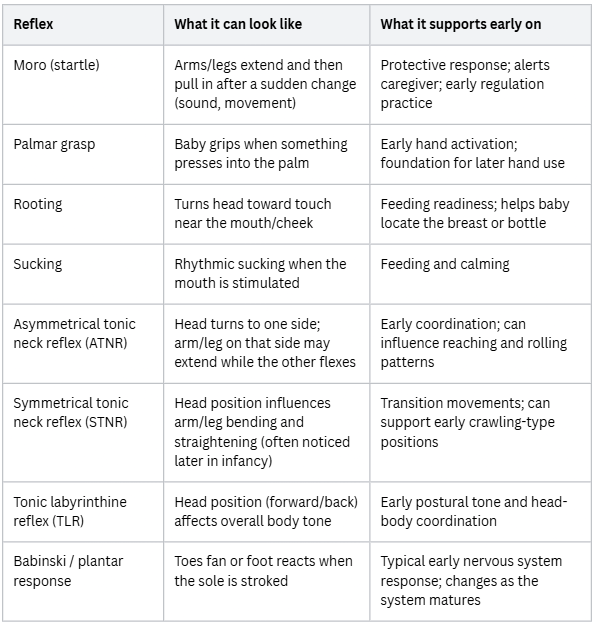
From Reflexes to Voluntary Movement
In early life, reflexes can help a baby “find” movement. With repetition—plus growth, tummy time, varied positions, and everyday play—the nervous system gains practice coordinating muscles, senses, and balance.
Over time, children typically develop more voluntary control, meaning they can start and stop actions, shift between positions, and adapt movements to different environments (for example, reaching for a toy from sitting or adjusting balance on uneven ground).
How reflexes support early movement development
Survival skills — feeding and protective responses early on
Body awareness — linking touch, head movement, and muscle tone
Foundations for posture — building the groundwork for head control, rolling, sitting, and crawling
Practice for coordination — repeated patterns that can later become refined skills
How Do Primitive Reflexes Relate to Organisation?
When people talk about organisation in development, they are referring to a child's ability to coordinate body systems efficiently—including posture, movement, balance, sensory processing, attention and emotional regulation. Primitive reflexes contribute to this organisation because they influence how the nervous system automatically responds to sensory input during early development.
As the nervous system matures and primitive reflexes become integrated, children generally develop greater flexibility and control over posture, eye movements, hand use, balance and attention. This supports increasingly efficient movement and participation in everyday activities such as sitting, playing, dressing, learning and social interaction.
As reflexes become less dominant, many children gain more flexibility in how they hold their posture, use their hands, move their eyes, and shift attention. This can support everyday tasks like sitting at a table, playing on the floor, dressing, and participating in learning and social interaction.
Keep in mind — Organisation is multifactorial. Primitive reflexes are only one piece of the puzzle. Sleep, vision, hearing, temperament, sensory processing, strength, coordination, health and the environment all influence how a child functions from day to day.
What Are Retained Primitive Reflexes?
A retained primitive reflex generally refers to a reflex pattern that remains more active or influential than expected as a child gets older. Instead of fading into the background, the automatic response may still “show up” and shape posture, movement choices, or reactions to sensory input.
It’s important to be medically cautious here: reflex persistence is not, by itself, a diagnosis. Children can show reflex-like patterns for many reasons, including typical variation, fatigue, anxiety, sensory sensitivities, or challenges with strength and motor planning. That’s why concerns are best explored through a thorough, whole-child assessment.
What “integration” can mean in practical terms
Rather than a reflex disappearing overnight, integration is often described as the nervous system developing enough control and flexibility that voluntary movement can override automatic patterns when needed.
Possible Signs That Warrant Assessment
If you’re noticing patterns that persist, interfere with daily activities, or cause distress, it can be helpful to discuss them with a qualified professional (such as a pediatrician, child health nurse, physiotherapist, occupational therapist, or other clinician appropriate to your setting).
Signs that may be worth checking in about
Ongoing difficulty with feeding skills (beyond expected phases) or persistent gagging/choking concerns
Strong startle responses that seem frequent or disruptive outside of typical infancy
Stiffness or floppiness that makes positioning, play, or transitions between positions challenging
Difficulty using both sides of the body (for example, consistently avoiding turning the head one way or using one hand far more than expected)
Challenges with balance, coordination, or frequent falls compared with peers (once walking is established)
Difficulty sitting still or maintaining posture for age-appropriate activities (with context: fatigue, interest level, and environment matter)
Sensory sensitivities that impact daily life (for example, distress with touch, movement, noise, or grooming)
Fine-motor struggles that affect participation (buttons, cutlery, drawing) or cause significant frustration
Big differences between settings (fine at home but struggling at school/childcare, or vice versa), suggesting environment plays a role
Medical caution — These signs are not specific to retained reflexes. They can overlap with many common developmental variations and other factors. A good assessment considers the whole child, their history, and how they function across environments.
Looking Beyond the Reflex
Reflexes are a helpful lens for understanding early development—but they’re only one lens. If you’re worried, the most useful questions are often practical and child-centered:
Is my child comfortable and confident in movement and play?
Are challenges getting in the way of daily life (sleep, feeding, dressing, school participation, social play)?
Do difficulties show up consistently across time and settings?
What supports help (routine changes, environmental adjustments, skill-building, stress reduction)?
Support may involve strengthening foundational skills (like core stability and balance), building motor planning through play, adapting the environment, or addressing broader needs such as sleep, anxiety, sensory processing, vision/hearing, and communication—depending on what the assessment finds.
Final Thoughts
Primitive reflexes are a normal, important part of early life. They help babies begin the journey from automatic responses to purposeful movement—and that journey looks a little different for every child.
If something doesn’t feel quite right, trust your instincts and seek advice. The most helpful approach is one that stays curious, avoids jumping to conclusions, and looks at the whole child: their strengths, their challenges, their environment, and how they’re participating in everyday life.
References:
Adolph KE, Hoch JE. Motor Development: Embodied, Embedded, Enculturated, and Enabling. Annual Review of Psychology. 2019;70:141–164.
Bly L. Motor Skills Acquisition in the First Year: An Illustrated Guide to Normal Development. Therapy Skill Builders.
Capute AJ, Accardo PJ. Developmental Disabilities in Infancy and Childhood.
Einspieler C, Prechtl HFR, Bos AF, Ferrari F, Cioni G. Prechtl’s Method on the Qualitative Assessment of General Movements in Preterm, Term and Young Infants. Mac Keith Press; 2019.
Goddard Blythe S. Assessing Neuromotor Readiness for Learning.
Goddard Blythe S. The Well Balanced Child: Movement and Early Learning.
Shumway-Cook A, Woollacott MH. Motor Control: Translating Research into Clinical Practice. 6th ed. Wolters Kluwer; 2021.
This article provides general developmental information and does not replace an individual assessment by your child’s healthcare professional.