Beyond Developmental Milestones: How Your Baby Moves, Functions and Develops
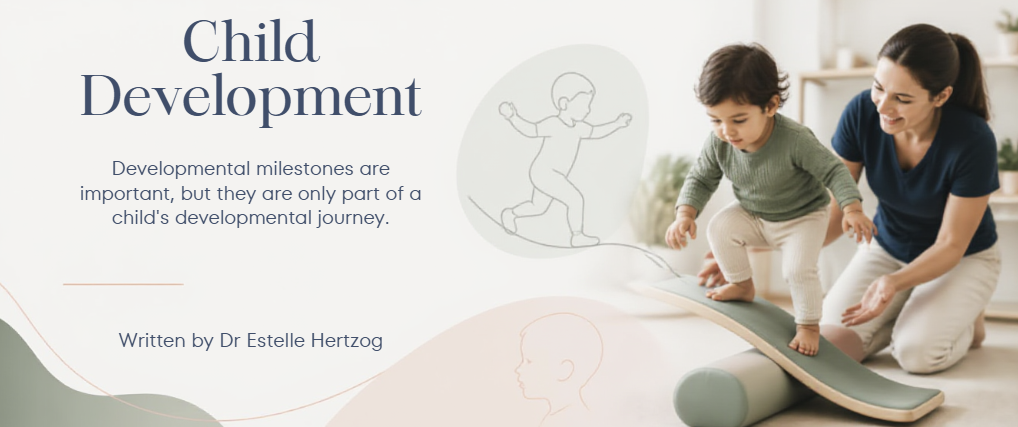
Organisation, movement quality, function, and outcome—what they reveal about your child’s development
Meta description: Developmental milestones are useful, but they’re only one part of the story. Learn how organisation, movement, function and outcome work together to support healthy child development.
“Is my child developing normally?”
If you’ve ever typed that question into a search bar at 2 a.m., you’re not alone. Many parents turn to developmental milestones for reassurance—those familiar charts that list when babies typically roll, sit, crawl, stand, and walk.
Milestone charts can be genuinely helpful. But they mostly tell you what a child can do—not how they’re doing it. And that “how” matters, because it reflects the foundations of child development: coordination, confidence, endurance, and growing independence in daily life.
Milestones are the visible result. The process underneath is what shapes long-term motor development.
1. What Are Developmental Milestones?
Developmental milestones are age-related skills that many children learn in a predictable sequence. They often include movement milestones (like rolling or walking), communication and social skills, and everyday abilities such as feeding and dressing.
In the early years—especially during infant development—milestones are often discussed as “baby milestones” and tend to spotlight gross motor changes such as:
Rolling and reaching for toys
Sitting with then without support
Crawling and climbing over small obstacles
Pulling to stand, cruising, standing independently
Walking, then running and jumping later on
These guideposts can flag when a child may need extra support. But they don’t fully capture the quality of motor development—the organisation, control, and problem-solving that make movement practical in everyday life.
2. Development Is a Process
It can be tempting to think of development as a checklist: roll, sit, craw and walk. In reality, it’s more like building a house—each new skill depends on the strength of what came before.
For example, a baby doesn’t just “learn to roll.” They learn to shift weight, organise their body against gravity, coordinate head and eyes, and link trunk and hips. Rolling is the outcome; the real story is the process underneath.
That’s why experiences like tummy time, floor play, and simple everyday movement opportunities matter. Time on the floor—reaching, pivoting, rolling, pushing up—builds the foundations that later support crawling, standing, and walking.
Parent-friendly reframe: Instead of only “Can my child do it yet?”, try “What is my child learning while they try?”
3. Looking Beyond the Milestone
When you look beyond developmental milestones, four connected pieces become easier to see: Organisation, Movement, Function, and Outcome. This lens works at any age—from early infant development to preschool running and jumping—because it focuses on how development is happening, not only whether a milestone shows up “on time.” The Organisation → Movement → Function → Outcome framework used in this article integrates principles from dynamic systems theory, developmental neuroscience and paediatric rehabilitation. It reflects the understanding that organised body systems support efficient movement, movement supports function, and function influences developmental outcomes
Organisation
Organisation is how your child’s body and nervous system “set up” for action. It includes posture, balance, muscle tone, endurance, attention, and coordination between both sides of the body.
You might notice organisation in small ways: does your baby settle into tummy time and gradually build tolerance, or quickly fatigue and slump? Can they bring hands to midline to explore a toy, or do they arch and push away? These patterns shape how easily later movement milestones emerge.
Movement
Movement is the quality and variety of how your child moves—rolling, reaching, pivoting, crawling, climbing, standing, walking, running, and jumping. It includes control, symmetry, and adaptability.
For instance, two babies might both roll, but one rolls smoothly with an easy weight shift, while another flips with a stiff extension pattern. Both “achieved the milestone,” yet their movement strategies differ—and that can matter later for crawling, climbing, and outdoor exploration on varied surfaces.
Function
Function is how movement supports real-life participation. It’s not just “Can they sit?” but “Can they sit and play with both hands?” Not just “Can they walk?” but “Can they walk where they want to go, carry a toy, and stop safely?”
Function shows up in everyday routines: floor play, reaching for toys, mealtimes, bath time, getting in and out of the car, climbing at the playground, and moving around outdoors with curiosity.
Outcome
Outcome is the end result you can observe—your child rolls, sits, crawls, stands, walks, runs, or jumps. Outcomes are the easiest part to measure, which is why baby milestones charts focus on them.
But outcomes don’t tell you everything. A child may reach an outcome “on time” while using a strategy that is less efficient, more tiring, or less adaptable—especially when the environment changes (uneven grass, stairs, busy play areas, or when they’re excited and moving fast).
Key takeaway: Milestones are the headline. Organisation, movement, and function are the foundation that supports lasting child development.
4. Why Two Children Can Reach the Same Milestone Differently
It’s completely normal for children to follow different paths. Two babies may reach the same developmental milestone at a similar age, yet the journey—and the underlying motor development—can look very different.
Here are a few parent-friendly examples of what that can look like:
Rolling: One baby discovers rolling through lots of rolling and reaching during floor play, shifting weight side to side. Another may roll mainly by arching and “flipping” quickly. Both roll, but their underlying motor development patterns aren’t the same.
Sitting: One child sits with a stable trunk and free hands for problem-solving play (stacking, banging toys, turning pages). Another sits by locking their legs wide and using their hands for balance, which can limit exploration and fine motor learning.
Crawling and climbing: Some babies crawl with good coordination and happily climb over cushions, up small steps, or across different surfaces. Others prefer bottom-shuffling or move in a less organised way, which may still “work,” but can change the opportunities they get for strength, balance, and coordination.
Standing and walking: One toddler may stand with aligned feet and shift weight easily to step around obstacles. Another might stand on tiptoes, keep feet wide, or rely heavily on furniture. The outcome (walking) can appear, but the movement quality affects stamina, safety, and confidence—especially during outdoor exploration.
Differences like these don’t automatically mean something is “wrong.” They’re information. Looking beyond milestones helps you notice whether your child’s foundations are supporting flexible, efficient movement—skills that matter for later running, jumping, and confident participation in play.
5. Supporting Healthy Development
The best support is usually simple, playful, and consistent. You don’t need fancy equipment—just opportunities for safe movement, exploration, and connection. Below are practical ideas that support organisation, movement, and function while respecting your child’s unique pace of infant development.
Everyday supports you can try
Prioritise tummy time in short, frequent bursts (especially when your baby is calm). Build tolerance gradually.
Choose floor play over containers when you can. Time on the floor makes rolling and reaching more likely to emerge naturally.
Offer toys slightly to the side (not always directly in front) to encourage weight shift, reaching, and rolling.
Create “movement invitations”: a cushion to crawl over, a low step to climb onto with help, or a tunnel made from a box—great for crawling and climbing practice.
Support outdoor exploration when possible. Grass, slopes, sand, and playground surfaces gently challenge balance and coordination in ways indoor floors can’t.
Include problem-solving play: hide a toy under a cloth, place a favourite item just out of reach, or build simple obstacle courses. Movement and thinking grow together in child development.
Gentle reminder: Your role isn’t to “train” baby milestones—it’s to offer experiences that help your child organise their body, explore movement, and use new skills in meaningful ways.
6. Why Looking Beyond Milestones Matters
When you zoom out from baby milestones charts, you get a fuller picture of your child’s development. You can notice:
Early strengths (great curiosity, varied movement, strong problem-solving play) that might not show up on a milestone list
Areas to nurture (fatigue in tummy time, limited variety in movement, difficulty using hands freely in sitting) before they become bigger challenges
How skills transfer from one setting to another—home to playground, flat floor to outdoor exploration, calm play to excited running and jumping
In other words, developmental milestones are a helpful starting point, but they’re not the whole story. The foundations—organisation, movement quality, and function—support confident, adaptable motor development over time.
7. Final Thoughts
If you’re wondering “Is my child developing normally?”, know that it’s a caring question—not a sign you’re doing anything wrong. Milestone charts can guide you, but your day-to-day observations matter too: how your child moves, explores, solves problems, and participates in play and routines.
This broader lens (organisation, movement, function, and outcome) is a reminder that healthy development is built on strong foundations—not just a list of outcomes. When you support those foundations, you support your child’s whole developmental journey.
Gentle call to action: If you’re feeling unsure about movement milestones (rolling, sitting, crawling, standing, walking, running, or jumping), consider guidance from a qualified child development professional who can assess the process—not only the milestone. A supportive check-in can bring clarity, practical next steps, and peace of mind.
References:
Adolph KE, Hoch JE. Motor Development: Embodied, Embedded, Enculturated, and Enabling. Annual Review of Psychology. 2019;70:141–164.
American Academy of Pediatrics, Lipkin PH, Macias MM, Council on Children With Disabilities. Promoting Optimal Development: Identifying Infants and Young Children With Developmental Disorders Through Developmental Surveillance and Screening. Pediatrics. 2020;145(1):e20193449.
Case-Smith J, O’Brien JC. Occupational Therapy for Children and Adolescents. 8th ed. Elsevier; sections on motor development and functional performance.
Centers for Disease Control and Prevention (CDC). Learn the Signs. Act Early. Developmental Milestones. Updated milestone guidance.
Hadders-Algra M. Early Human Motor Development: From Variation to the Ability to Vary and Adapt. Neuroscience & Biobehavioral Reviews. 2018;90:411–427.
Shumway-Cook A, Woollacott MH. Motor Control: Translating Research into Clinical Practice. 6th ed. Wolters Kluwer; 2021.
Thelen E, Smith LB. A Dynamic Systems Approach to the Development of Cognition and Action. MIT Press; 1994.
World Health Organization. WHO Motor Development Study: Windows of Achievement for Six Gross Motor Development Milestones. Geneva: WHO; 2006.
This article provides general developmental information and is not intended to diagnose developmental difficulties or replace an individual assessment by your child’s healthcare professional.