Understanding Walking: From First Steps to Confident Movement
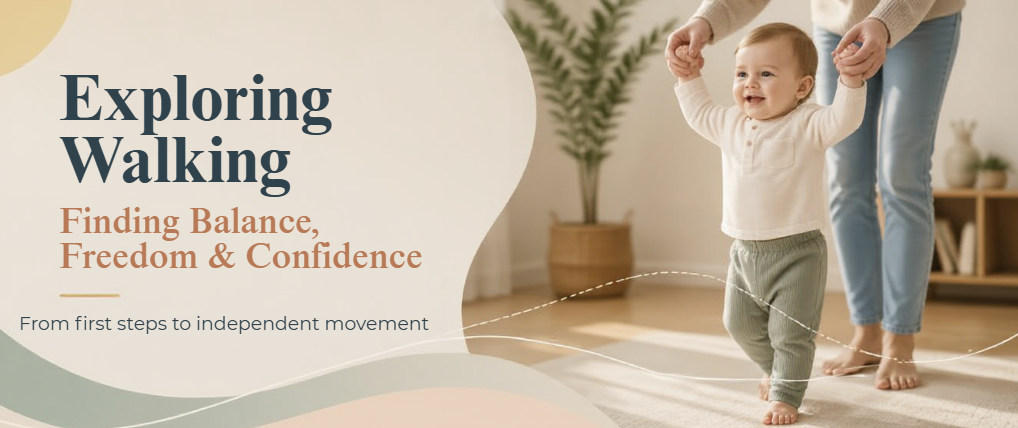
A baby's first independent steps are one of the most recognisable developmental milestones.
But walking does not suddenly appear as a finished skill.
Those first few steps are the beginning of another period of learning. Your baby now has to control their body upright without holding onto something for support, shift their weight from one leg to the other and continually adjust when balance changes.
Early walking can therefore look wide, wobbly and uncertain — and quite different from the walking pattern that develops with experience.
Learning to walk is not simply about taking more steps. It is about becoming increasingly balanced, controlled and adaptable while moving upright.
What changes when a baby starts walking independently?
Before independent walking, babies can use furniture, another person or their hands to provide additional support.
Once they let go, the challenge changes.
With every step, your baby has to shift their body weight onto one leg while the other moves forward. The trunk, pelvis and legs work together to keep the body moving while balance is continually adjusted.
At the same time, your baby is learning to judge where they are going, respond to the surface beneath their feet and adapt when something changes.
Walking is therefore much more than putting one foot in front of the other.
It is a developing balance and movement skill.
Why do new walkers look so different?
Early walking is not simply a smaller version of adult walking.
New walkers commonly use strategies that help them manage balance while the skill is still developing.
You may notice:
a wide base between the feet
short, variable steps
the feet landing relatively flat
the arms held high or out to the sides
frequent stopping and starting
lots of small balance corrections
frequent falls
With experience, steps generally become longer, narrower and more consistent, and babies become increasingly able to control where they are going.
Why are the arms held up?
One of the most noticeable features of a new walker is the position of the arms.
Babies often walk with their arms held high and away from their bodies — sometimes described as a high-guard position.
This is commonly seen during early walking while balance is still developing.
As walking becomes more secure, the arms usually begin to lower and become freer for other tasks such as reaching and carrying objects.
Rather than trying to correct the position, watch how your baby's use of their arms changes as walking becomes more confident.
Walking develops gradually
Like the milestones that came before it, walking changes considerably with experience.
Emerging
First steps may be brief and unpredictable.
Your baby may:
take only a few independent steps
walk with the feet wide apart
hold the arms high or out to the sides
use short, variable steps
move quickly towards another support
frequently drop to the floor
return to crawling when they want to move quickly
find stopping or changing direction difficult
At this stage, simply remaining upright while moving is a significant challenge.
Developing
As experience grows, walking usually becomes more controlled.
You may notice your baby:
taking longer sequences of steps
walking across larger spaces
gradually narrowing their base
stopping with greater control
beginning to turn while walking
lowering their arms more often
carrying objects while moving
recovering from small losses of balance
exploring different safe surfaces
Walking is becoming less about simply staying upright and more about getting somewhere.
Mastering
With further experience, walking becomes increasingly adaptable.
Your child may begin to:
start and stop more easily
change direction
squat down and stand again
rise from the floor towards standing with decreasing reliance on furniture or other support
carry and manipulate objects while walking
step around obstacles
adjust to different surfaces
increase and decrease speed
walk while looking somewhere other than directly ahead
begin experimenting with faster walking and eventually running
The important change is not that every step becomes identical.
It is that your child has more movement options available.
Falling is part of learning
New walkers fall — often.
Walking requires babies to continually discover the limits of their balance: how far they can lean, how quickly they can move, how large a step they can take and what happens when the environment changes.
As experience grows, they become better at adjusting their movements and recovering from small losses of balance.
The goal is therefore not to prevent every ordinary fall during safe exploration.
It is to provide an environment where your baby can practise without unnecessary hazards.
Walking becomes more adaptable
Walking across an open room is only the beginning.
Real environments contain corners, toys, changes in flooring, people moving past and objects to carry.
Vision is part of this adaptation too. Early walkers may watch the floor or their feet closely, while increasing experience allows them to look around, judge obstacles and direct their attention elsewhere while continuing to move.
As walking develops, your baby learns to adjust to these changing demands.
They may step around a toy instead of falling over it, turn towards someone while continuing to move, carry an object without losing balance or slow down when the surface changes.
Confident walking is not simply the ability to move forward. It is the ability to adapt movement to the situation.
What about asymmetry?
Early walking is naturally variable.
One step may look different from the next, and a newly walking baby does not need to demonstrate a perfectly symmetrical adult walking pattern.
What matters more is the pattern over time.
Patterns worth noticing include:
consistently avoiding weight through one leg
repeatedly dragging the same leg
a persistent marked difference between the two sides
one leg appearing consistently much stiffer than the other
an asymmetry that is also present during other movement skills
An isolated unusual step is very different from a pattern that persists across positions and activities.
Movement does not need to be perfectly symmetrical. What you want to see is increasing variety and progression over time.
What about toe walking?
Babies may occasionally rise onto their toes while experimenting with standing and walking.
Occasional toe walking can occur during early development.
It becomes more worth noticing when a child persistently walks high on the toes, rarely brings the heels down, cannot comfortably place the heels on the floor, or when the pattern occurs alongside stiffness, asymmetry or other developmental concerns.
As with other movement patterns, context matters.
One moment tells you very little. A persistent pattern tells you more.
When do babies usually walk?
There is a wide range of normal variation.
In the WHO Motor Development Study, healthy children achieved independent walking across a broad window of approximately 8.2 to 17.6 months.
The CDC includes walking without holding onto anyone or anything as a milestone most children achieve by 18 months.
These ages are useful reference points, not deadlines for predicting the exact day an individual baby should walk.
Development should always be considered alongside the child's overall progress and developmental picture.
Barefoot when practical
In a safe environment, barefoot walking allows the feet and toes to move freely and gives babies direct contact with the surface beneath them.
Shoes are useful when protection is needed, particularly outdoors. Babies do not need rigid or highly structured footwear simply to learn to walk.
When shoes are needed, comfortable, appropriately fitting footwear that allows movement is generally suitable.
What about baby walkers?
There is an important difference between a push toy and a seated mobile baby walker.
A sturdy push toy may provide another opportunity for supported movement once a baby has sufficient standing balance and control to manage a moving support safely. It is not necessary for learning to walk and should not be used to rush the process.
Seated mobile baby walkers are different. They support the baby inside a wheeled frame and are not recommended because of their injury risk. They do not provide the same balance experience as independently controlling the body during standing and walking.
Floor play, pulling to stand, cruising, standing and freely exploring movement provide plenty of opportunities for developing upright movement.
Small things worth noticing
Instead of looking only at whether your baby is walking, look at how walking changes with experience.
Notice whether your baby is:
taking increasingly confident steps
walking over greater distances
using both legs in varied ways
gradually relying less on early balance strategies
learning to stop and change direction
recovering from small losses of balance
carrying and reaching for objects while walking
adapting to different safe surfaces
finding new ways around obstacles
You are not looking for a perfect walking pattern.
You are looking for progression, variety and adaptability.
When might walking be worth assessing?
One unusual movement or occasional fall does not diagnose a developmental problem.
Consider discussing your child's development with an appropriately qualified healthcare professional if you notice:
a persistent marked difference in how the two legs are used
consistently avoiding weight through one leg
persistent dragging of one leg
marked stiffness or floppiness affecting movement
persistent toe walking with the heels rarely coming down
frequent falling that does not appear to improve as walking experience increases
a strong asymmetry across several movement skills
loss of a previously acquired motor skill
little progression in overall movement abilities over time
independent walking has not emerged within the expected broad developmental window
Assessment is not simply about deciding whether a child is walking at the “correct” age.
It considers the whole developmental picture.
What can parents do?
Babies do not need formal walking lessons.
They need safe opportunities to move and explore.
Allow plenty of floor time and opportunities to move naturally between crawling, pulling to stand, cruising, standing and walking.
Stable furniture can provide opportunities for cruising and moving between supports. As confidence grows, open safe spaces allow babies to experiment with independent standing and steps.
Try not to continually walk your baby around by holding both hands above their head. Some supported play is fine, but independent balance develops when babies increasingly take responsibility for controlling their own bodies.
And don't worry if your new walker still chooses to crawl sometimes.
When speed or stability matters, crawling may simply remain the easier option for a while.
The bigger developmental picture
A baby's first steps are exciting, but they are not the end of gross motor development.
They are the beginning of a new phase.
Over time, walking becomes more controlled and adaptable. Your child learns to stop, turn, squat, carry objects, negotiate obstacles and eventually run.
The new walker taking a few uncertain steps between the couch and your arms is learning much more than how to put one foot in front of the other.
They are learning how to control a moving body in an upright world.
Development is not about producing a perfect walking pattern as quickly as possible.
It is about building an increasingly varied, adaptable and confident movement repertoire.
References
Adolph KE, Berger SE, Leo AJ. Developmental continuity? Crawling, cruising, and walking. Developmental Science. 2011;14(2):306–318.
Adolph KE, Cole WG, Komati M, et al. How do you learn to walk? Thousands of steps and dozens of falls per day. Psychological Science. 2012;23(11):1387–1394.
Adolph KE, Vereijken B, Shrout PE. What changes in infant walking and why. Child Development. 2003;74(2):475–497.
American Academy of Pediatrics. Movement Milestones in Babies 8 to 12 Months Old. HealthyChildren.org.
Centers for Disease Control and Prevention. Milestones by 18 Months. Learn the Signs. Act Early.
WHO Multicentre Growth Reference Study Group. WHO Motor Development Study: windows of achievement for six gross motor development milestones. Acta Paediatrica. 2006;95(S450):86–95.
Educational disclaimer:
This article is intended for general educational purposes and does not replace an individual developmental or medical assessment.