Understanding Cruising: Learning to Move Sideways Before Moving Forward
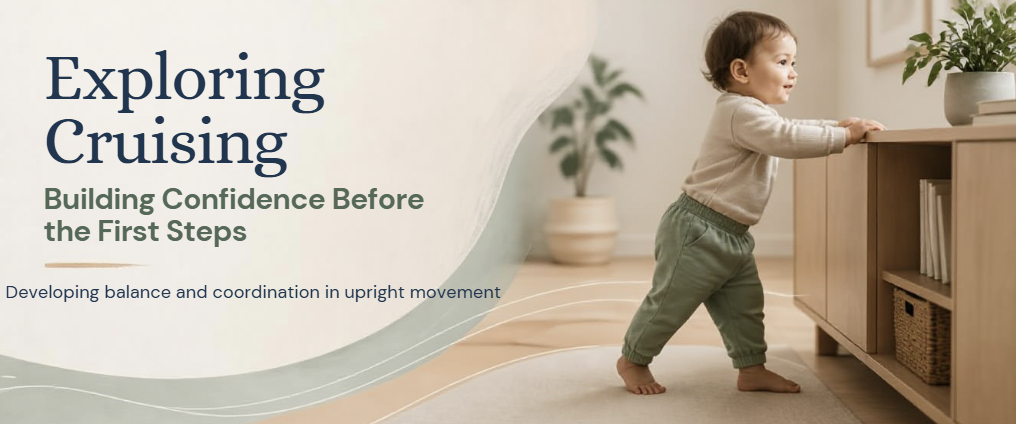
Before many children take independent steps, they spend time moving sideways while holding on to furniture.
This stage is called cruising. It can look simple from the outside, but it involves a growing ability to shift weight, coordinate both sides of the body, use the hands for support, and make careful movement decisions.
Cruising is not a race or a single event. It develops gradually, and children may show different parts of the skill at different times. Watching the quality and variety of movement can offer more useful information than focusing on one exact age or comparing one child with another.
What is cruising?
Cruising is moving along the edge of a stable surface while holding on with the hands. A child may step sideways along a sofa, move between nearby pieces of furniture, or briefly let go and reach for the next support.
The movement is different from walking independently because the hands still provide balance and security. Even so, cruising gives a child valuable practice with the same foundations that later support forward movement: standing upright, transferring weight, coordinating the legs, and recovering from small changes in balance.
Key idea: Cruising is more than “walking along furniture.” It is a period of learning how the body organizes balance and movement while support is still available.
What is happening underneath?
When a child cruises, the body is constantly making small adjustments. One leg accepts more weight while the other leg moves. The trunk stays upright, the feet respond to the floor, and the hands help manage balance without doing all of the work.
The child is also learning to coordinate movement across the two sides of the body. This includes turning the pelvis, moving the legs in a sequence, and using the eyes to plan where to go next. These changes can make cruising look cautious, uneven, or stop-and-start, especially while the skill is new.
Cruising develops gradually
Emerging
In the emerging stage, a child may pull to stand and remain upright while holding on. Sideways movement may begin with small steps, a wide base of support, or a strong reliance on the arms. The child may move only a short distance before sitting down or returning to a familiar position.
Developing
As cruising develops, the steps may become more frequent and purposeful. A child may move in both directions, reach farther between supports, and pause to regain balance. The hands may begin to provide lighter support as the legs and trunk take on more of the work.
Mastering
With practice, a child may cruise farther, turn around corners, transfer between nearby surfaces, and manage small changes in direction. Some children begin to briefly release one hand, stand momentarily, or take a step toward another support. These actions are signs of expanding control, not requirements that every child must demonstrate in the same order.
Developmental nuance: Progress may be uneven. A child can appear confident in one part of cruising and cautious in another, such as turning, reaching, or moving away from a preferred side.
Why weight shifting matters
Sideways stepping depends on moving the body’s weight from one leg to the other. A child must load one foot enough to free the opposite leg, then place that leg without losing balance. This weight shift is repeated with every step and becomes more refined through practice.
Weight shifting also helps a child learn that balance is dynamic rather than fixed. The body does not need to stay perfectly still; it needs to adjust as the center of weight changes. Reaching, turning, and stepping all ask for slightly different adjustments.
Learning to get back down
Getting down from standing is part of the skill, too. A child may bend the knees, lower through the hips, turn toward a stable surface, or move from standing into sitting. Early attempts can look abrupt or awkward because lowering requires controlled movement rather than simply letting gravity take over.
The ability to return to the floor gives a child another way to manage balance and choose when to pause. It is not just the opposite of pulling up; it is a separate movement problem that develops with experience.
Cruising in both directions
Moving to the right and moving to the left may place slightly different demands on balance and coordination. Children may initially prefer one direction or one side of the body. Cruising in both directions provides opportunities to practice shifting weight, coordinating each leg, and using each arm in different roles.
The hands change too
At first, the hands may grip firmly and carry much of the child’s weight. Over time, the grip may become lighter, the elbows may straighten, and one hand may reach while the other maintains contact. A child may also move from holding with both hands to holding with one, depending on the task and the level of confidence.
These changes do not need to appear all at once. Hand use can vary with fatigue, surface height, speed, and how familiar the route feels.
When the environment becomes more challenging
Cruising on a long, straight sofa is different from moving around a corner or between two surfaces. A change in the environment may require a child to rotate the trunk, reach farther, adjust the feet, or decide whether a new support is close enough to use.
Small gaps, different surface heights, corners, and objects that move can all make the task more demanding. A child may slow down, stop, return to a familiar position, or choose a different route. These pauses are part of learning how to judge the environment.
What about the feet?
The feet help provide a stable base and information about the floor. While cruising, a child may use a wide stance, turn the feet outward, lift the heels, or take short steps. These patterns can change as balance and coordination improve.
Foot placement is influenced by the surface, footwear, the height of the support, and how the child is trying to move. Looking at the whole movement is more informative than judging one foot position in isolation.
Barefoot when practical
When it is safe and practical, being barefoot can allow a child to feel the floor directly and move the feet without the structure of a shoe. This may be useful during indoor practice on an appropriate, supervised surface.
Shoes may still be appropriate for warmth, protection, outdoor surfaces, or other practical needs. The goal is not to make every movement barefoot; it is to provide varied, safe opportunities for movement.
What about push walkers?
Push walkers can offer a different experience from cruising along furniture. They move through space, so the child must respond to the walker’s movement as well as manage standing and stepping. A stable, appropriately designed walker on a clear surface may be easier to control than a light or fast-moving object.
A push walker is not necessary for learning to walk, and it does not guarantee faster progress. If one is used, close supervision and attention to the environment matter because the object can roll toward hazards or move faster than the child can manage.
Small things worth noticing
Rather than looking only for a particular milestone, notice how the child approaches movement. Useful observations may include:
Direction — Does the child move in both directions, or strongly prefer one?
Support — Are the hands gripping firmly, resting lightly, or changing roles during movement?
Weight shift — Can the child free one leg to step, reach, or turn?
Transitions — Can the child lower from standing, pause, and return to the floor?
Adaptability — Does the child adjust when the route, surface, or distance changes?
Variation — Does movement look different when the child is tired, excited, or working in a less familiar space?
These observations describe the child’s current experience; they are not a test that a child must pass in a fixed order.
When might cruising be worth assessing?
Cruising may be worth discussing with a qualified health professional when a parent or caregiver notices a persistent concern about movement, a clear loss of a skill the child previously used, marked difficulty using one side, or movement that consistently seems painful or unusually effortful.
The reason to seek an assessment is not to compare a child with a timetable. It is to understand the child’s individual pattern, answer questions, and decide whether extra support or observation would be useful.
What can parents do?
Parents can support learning by making everyday movement opportunities safe, calm, and interesting:
Create a clear path beside stable furniture so the child can move without unnecessary obstacles.
Place interesting but safe objects within reach, sometimes to each side, without requiring a particular movement.
Allow time for the child to start, pause, change direction, and get down.
Offer varied surfaces and routes when appropriate, while staying close enough to supervise.
Notice effort and exploration rather than turning movement into a performance.
Use footwear that fits the situation and does not create an avoidable barrier to movement.
Helpful mindset: Make room for practice, but let the child set the pace. Support can provide security without taking over the movement.
The bigger developmental picture
Cruising is one part of a broader developmental process. It connects standing, balance, transitions, reaching, turning, foot placement, and early stepping. It also gives children opportunities to solve movement problems: how far to reach, when to pause, which support to use, and how to return safely to the floor.
Children do not all move through these experiences in identical ways. Some spend a long time cruising before letting go; others briefly explore unsupported standing or stepping alongside it. Development can be flexible while still showing meaningful progress over time.
The most helpful focus is on the child’s overall movement, comfort, participation, and gradual learning. Cruising is not a competition and does not need to look polished to be valuable.
References
Adolph KE, Berger SE, Leo AJ. Developmental continuity? Crawling, cruising, and walking. Developmental Science. 2011;14(2):306–318.
Berger SE, Adolph KE, Lobo SA. What cruising infants understand about support for locomotion. Infancy. 2014;19(2):117–137.
Karasik LB, et al. Social dynamics of supported walking in 11-month-old infants. Infant Behavior and Development. 2024;77:101994.
Shiraga K, Negayama K. Longitudinal development of infants' cruising in the home. Japanese Journal of Developmental Psychology. 2008;19(4):375–388.
WHO Multicentre Growth Reference Study Group. WHO Motor Development Study: windows of achievement for six gross motor development milestones. Acta Paediatrica. 2006;95(S450):86–95.
Educational disclaimer
This article is for educational purposes only. It is not medical advice and does not diagnose, treat, or rule out any condition. Development varies from child to child; if you have concerns about a child’s movement or development, discuss them with a qualified health professional.