Concussion: More Than A Bump To The Head
Concussion isn’t always obvious.
A child can “seem fine” at first, keep playing, or only show mild changes that are easy to miss—especially when adrenaline, excitement, or fear is involved.
This article explains what concussion is, what to watch for, what to do early on, and how to support a safe, complete recovery—at home, at school, and in sport.
1. Introduction: concussion can look subtle—and is often missed
Many people picture concussion as a dramatic hit followed by immediate symptoms. In reality, concussion symptoms can start minutes to hours later, and they can be physical, emotional, or behavioural—not just a headache.
Because signs may be subtle (or a child may minimize symptoms to keep playing), concussion can be missed unless you know what to look for and what questions to ask.
A child falls from a bicycle, collides with another player on the sports field, or takes a hard knock during play. They get up, they are talking, and there may be no visible injury. It can be tempting to think, “They seem fine.”
But a concussion does not always look dramatic.
A concussion is a traumatic brain injury caused by biomechanical forces that temporarily disrupt how the brain functions. A child does not have to lose consciousness, and there does not necessarily need to be a direct blow to the head. A force transmitted through the body can also cause rapid movement of the head and brain.
Understanding what happens during a concussion helps explain why symptoms can seem so varied, why recovery is different for every child, and why returning to school and sport should be gradual rather than rushed.
IMPORTANT
If you suspect a concussion, treat it seriously and start with safety first. It’s always better to be cautious and get the right medical guidance early.
2. What happens inside the brain?
The brain is soft tissue contained within the skull. During a rapid acceleration, deceleration or rotational movement, the brain is exposed to mechanical forces that can strain brain tissue and nerve fibres.
It is more accurate to think of this as axonal strain and cellular disruption rather than simply saying that the brain has been “bruised” or that axons have been “sheared.”
At a microscopic level, concussion triggers a complex series of chemical and metabolic events known as the neurometabolic cascade of concussion.
Following the injury, neuronal cell membranes become disrupted and there are changes in the normal movement of ions across these membranes. Following this disruption, potassium moves out of neurons while calcium can accumulate within cells, alongside changes in neurotransmitter activity
The brain immediately tries to restore its normal cellular balance.
That restoration requires energy.
The sodium-potassium pumps responsible for restoring normal ionic balance require adenosine triphosphate (ATP), the molecule cells use as an immediate source of energy. Energy demand therefore increases at exactly the time that normal cerebral energy metabolism may be impaired. Mitochondrial function can also be affected by calcium accumulation.
This creates what is often described as a temporary energy crisis or energy mismatch.
2.1 Why does this matter?
Concussion affects more than sport. It can impact learning, mood, sleep, balance, vision, and behaviour—things your child needs every day at school and at home.
Early recognition and an appropriate recovery plan can support recovery and help your child return to school, everyday activities and sport safely and progressively.
3. The neck matters too
Concussion does not necessarily occur in isolation.
The same acceleration, deceleration and rotational forces that move the head can also place considerable load on the cervical spine and surrounding muscles and joints.
This matters because symptoms arising from the neck can overlap with symptoms commonly attributed to concussion.
These may include headache, neck pain or stiffness, dizziness, disturbed balance and discomfort associated with head movement.
For this reason, a comprehensive assessment should consider both the neurological injury and the cervical system, particularly when neck pain, headache, dizziness or balance problems persist.
Current international concussion guidance recommends cervicovestibular rehabilitation when dizziness, neck pain and/or headaches persist beyond approximately 10 days, particularly in adolescents.
5. What might you notice?
Concussion symptoms can vary from child to child. You might notice one symptom—or a mix that changes over the day, especially with schoolwork, screens, noise, or physical activity.
Physical symptoms
Headache or pressure in the head
Nausea or vomiting
Dizziness or feeling “off”
Sensitivity to light or noise
Fatigue or low energy
Feeling worse with activity (physical or mental)
Thinking and concentration
Trouble focusing, reading, or following instructions
Feeling slowed down or “foggy”
Taking longer to answer questions
Forgetfulness (especially around the event)
Vision and balance
Blurred or double vision
Difficulty tracking words on a page
Unsteadiness, clumsiness, or poor balance
Dizziness triggered by busy environments (hallways, stores, sports fields)
Sleep
Sleeping more or less than usual
Trouble falling asleep or staying asleep
Feeling unrefreshed despite sleep
Mood and behaviour
Irritability, tearfulness, or mood swings
Anxiety or feeling unusually emotional
Withdrawal from friends/family or loss of interest in usual activities
Behaviour changes that feel “out of character”
Neck-related symptoms
Neck pain or stiffness
Headaches that worsen with neck movement or posture
Dizziness linked to turning the head
Shoulder/upper back tightness
Tip for parents
Ask, “What makes it worse?” and “What makes it better?” Symptoms that reliably worsen with reading, screens, noise, or activity can be a helpful clue—even if the symptom itself seems mild.
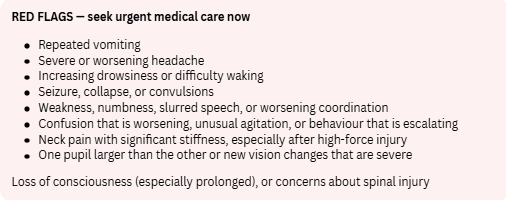
6. Red flags: when a concussion may be more than a concussion
Some symptoms suggest a more serious injury and need urgent medical assessment.
7. What should I do if I suspect a concussion?
Stop the activity right away. No same-day return to play.
Keep your child safe and supervised. Avoid risky activities (bike, trampoline, contact play).
Arrange medical assessment, especially if symptoms are significant, new, or worsening.
Document what happened and what you noticed (time, symptoms, triggers). This helps health professionals and schools support recovery.
IMPORTANT
Arrange assessment by an appropriately qualified healthcare provider. Seek urgent care if symptoms are worsening or any red flags are present.
7.1 The first 24–48 hours
Focus on calm, supported recovery—not strict bed rest, and not pushing through. Many children do best with relative rest: calm everyday activities as tolerated, with regular breaks when needed. Complete physical rest is no longer recommended. Light activity, such as short periods of walking, can begin during the first 24–48 hours if it causes no more than a mild and brief increase in symptoms. Activities with a risk of contact, collision or falling should still be avoided.
Helpful early steps may include:
Keeping things low-stimulation (dim lights if needed, reduced noise, short screen time)
Encouraging hydration and regular meals/snacks
Allowing sleep and downtime
Avoiding sport, rough play, and activities with fall risk
If symptoms quickly worsen, or red flags appear, seek urgent medical care.
7.2 Should I keep waking my child?
Sleep is an important part of recovery, and a child with a suspected concussion does not generally need to be repeatedly woken through the night simply because they have a concussion.
However, appropriate medical assessment remains important. If a healthcare provider has given you specific monitoring instructions, follow those instructions. If your child becomes increasingly drowsy, is difficult to wake, develops worsening symptoms or shows any red flags, seek urgent medical care.
7.3 What not to do after a concussion
Don’t let your child “push through” symptoms at school, sport, or activities.
Don’t allow same-day return to play or contact activities.
Don’t assume it’s only a headache—watch for changes in behaviour, sleep, and learning.
Don’t dramatically restrict all activity for long periods without guidance; too much restriction can also slow recovery for some children.
8. How is a concussion treated?
Concussion treatment is usually active and individualized. The goal is to reduce symptom triggers at first, then gradually build tolerance for thinking, movement, and daily life—without causing significant symptom spikes.
Treatment plans may include a combination of:
A step-by-step return to school (return-to-learn) and return to activity
Sleep support and routine building
Guidance on screen time and workload
Targeted rehabilitation (for example, balance/vestibular therapy, vision therapy, neck rehab) when needed
9. What about pain medication?
Pain relief can be appropriate for some children, but medication choices should be guided by a clinician—especially in the early period after injury, or if symptoms are worsening.
Avoid using medication to “mask” symptoms so your child can return to sport or full activity. Pain relief should support comfort and rest, not speed up risky return.
IMPORTANT
If headaches are severe, worsening, or different from your child’s usual headaches, seek medical advice rather than repeatedly increasing medication at home.
10. Returning to school: the brain needs to return to learning too
School is often the biggest “workout” for the recovering brain. Many children need temporary supports to reduce symptoms and prevent setbacks while they heal.
Common short-term school supports include:
Most children should return to school within 1-2 days, often while some symptoms remain, with temporary accommodations. They do not need to be completely symptom-free before returning to learning. Shortened school day or gradual re-entry.
Rest breaks (quiet space)
Reduced workload and postponed tests
Extra time for assignments and exams
Reduced screen-based work when it triggers symptoms
Communication matters: share the plan with the teacher, school office, and any learning support staff so expectations are consistent.
11. Recovery is more than “my headache is gone”
Headache may be the most noticeable symptom—but it’s not the only marker of recovery. A child may feel okay at rest but still struggle with reading, busy environments, or physical exertion.
Recovery involves more than feeling well at rest. Your child should progressively regain their ability to tolerate learning, daily activities and physical exertion without concussion-related symptoms or other clinical problems limiting function.
13. What if symptoms return with activity?
A mild and brief increase in symptoms can occur as activity is gradually increased during recovery and does not necessarily mean the activity is harmful.
If symptoms increase significantly, remain elevated, or continue to worsen, reduce the activity and return to a more manageable level. If symptoms repeatedly flare with minimal activity or recovery is not progressing, seek reassessment and targeted support.
14. When recovery takes longer
Some children recover quickly, while others take longer. Recovery can be influenced by many factors, including the severity and number of early symptoms, pre-existing migraine, sleep difficulties, anxiety or other psychological factors, as well as co-existing cervical, vestibular or vision-related problems.
If recovery is not progressing as expected, it’s worth checking whether there are treatable drivers (sleep, neck, vestibular, vision, mood) that need specific attention—not just more rest.
15. Rehabilitation: treat the child, not just the concussion
A good concussion plan looks at the whole child. Assessment may consider symptoms, cognition, balance, vision and eye movements, vestibular function, sleep, mood, cervical function and exercise tolerance, alongside school demands and daily activities.
Rehabilitation may involve a team approach, such as a medical provider plus physiotherapy or other therapies when indicated. The aim is to restore confidence and function—step by step—while keeping your child safe.
WHY THIS MATTERS
Persistent symptoms often improve when the specific contributors are identified and treated—rather than waiting for time alone to fix everything.
16. Final thoughts
Concussion can be scary because it’s not always visible—but you’re not powerless. Knowing what to look for, acting early, and following a structured return-to-learn and return-to-sport plan can make recovery smoother and safer.
If something doesn’t feel right, trust your instincts and seek professional advice. Most children recover well with the right support.
References
Centers for Disease Control and Prevention. (2025). Safety guidelines for pediatric mild TBI. National Center for Injury Prevention and Control.
CDC Pediatric Mild TBI GuidelinesCenters for Disease Control and Prevention. (2025). Signs and symptoms of concussion. HEADS UP.
CDC Concussion Signs, Symptoms and Danger SignsCenters for Disease Control and Prevention. (2025). Returning to school after a concussion. HEADS UP.
CDC Returning to School After ConcussionCenters for Disease Control and Prevention. (2025). Returning to sports. HEADS UP.
CDC Return-to-Sport ProgressionCenters for Disease Control and Prevention. (2025). Responding to a sports-related concussion. HEADS UP.
Davis, G. A., Schneider, K. J., Patricios, J. S., et al. (2024). Pediatric sport-related concussion: Recommendations from the Amsterdam Consensus Statement 2023. Pediatrics, 153(1), e2023063489.
AAP Pediatric Concussion RecommendationsGiza, C. C., & Hovda, D. A. (2001). The neurometabolic cascade of concussion. Journal of Athletic Training, 36(3), 228–235.
Giza, C. C., & Hovda, D. A. (2014). The new neurometabolic cascade of concussion. Neurosurgery, 75(Suppl. 4), S24–S33. https://doi.org/10.1227/NEU.0000000000000505
Patricios, J. S., Schneider, K. J., Dvorak, J., et al. (2023). Consensus statement on concussion in sport: The 6th International Conference on Concussion in Sport—Amsterdam, October 2022. British Journal of Sports Medicine, 57(11), 695–711.
Amsterdam 2022 Concussion Consensus StatementSchneider, K. J., Meeuwisse, W. H., Nettel-Aguirre, A., et al. (2014). Cervicovestibular rehabilitation in sport-related concussion: A randomised controlled trial. British Journal of Sports Medicine, 48(17), 1294–1298. https://doi.org/10.1136/bjsports-2013-093267.
This article is for general education and is not a substitute for medical assessment, diagnosis, or treatment. If you suspect a concussion, seek guidance from a qualified health professional. If red flags are present or symptoms are worsening, seek urgent medical care immediately.