When Sitting Shapes the Body
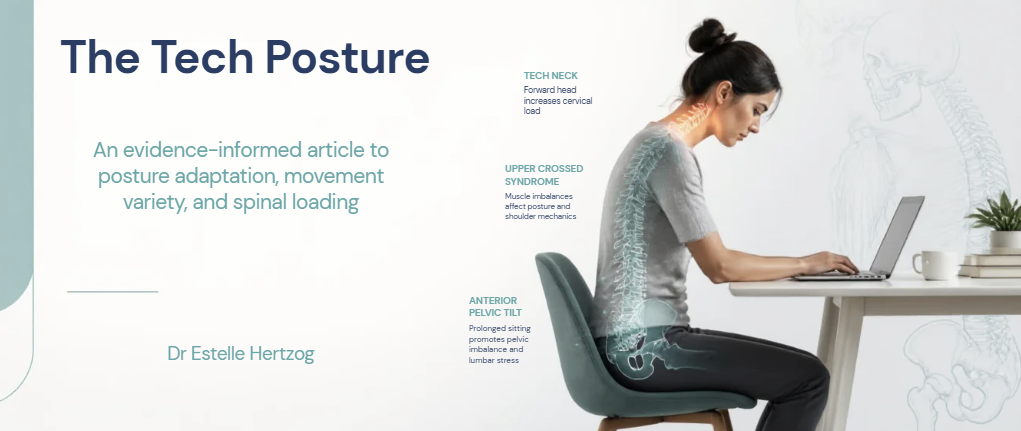
Understanding Tech Neck, Upper Crossed Syndrome and Anterior Pelvic Tilt.
Modern work and leisure often involve prolonged sitting, sustained attention to screens, and repetitive hand positions. These habits can influence how the head, ribcage, shoulders, pelvis, and spine organize themselves—sometimes gradually, sometimes noticeably, and often in ways that feel “normal” until discomfort appears.
This whitepaper explains how common postural presentations—tech neck, upper crossed syndrome, and anterior pelvic tilt—are often linked to repeated positioning plus reduced movement variability. It focuses on clear anatomy concepts (what tends to get tight, what tends to get weak or underused, and what tends to get stiff), and how these patterns may relate to symptoms such as neck tension, shoulder discomfort, low back tightness, and hip stiffness.
Scope: This document describes typical patterns and practical considerations for everyday desk and device use. It does not diagnose conditions or replace assessment by a qualified clinician, especially when symptoms are severe, progressive, or involve numbness, weakness, or radiating pain.
The Body Adapts to the Positions It Uses Most
Human tissues respond to repeated inputs. Muscles can become more tolerant (and sometimes more dominant) in the positions they frequently hold, while other muscles may become comparatively underused. Over time, this can influence resting posture, joint motion options, and the “default” strategies the body chooses for everyday tasks.
This does not mean posture is a moral failing or that a single posture is inherently “bad.” The bigger issue is often exposure: long durations in one position, repeated daily, with limited counterbalancing movement.
Common drivers — long sitting bouts, low step count, few overhead or rotation movements, and sustained forward focus at a screen.
Common result — the body becomes efficient at what it practices: a seated, forward-focused position.
What Happens During Prolonged Sitting?
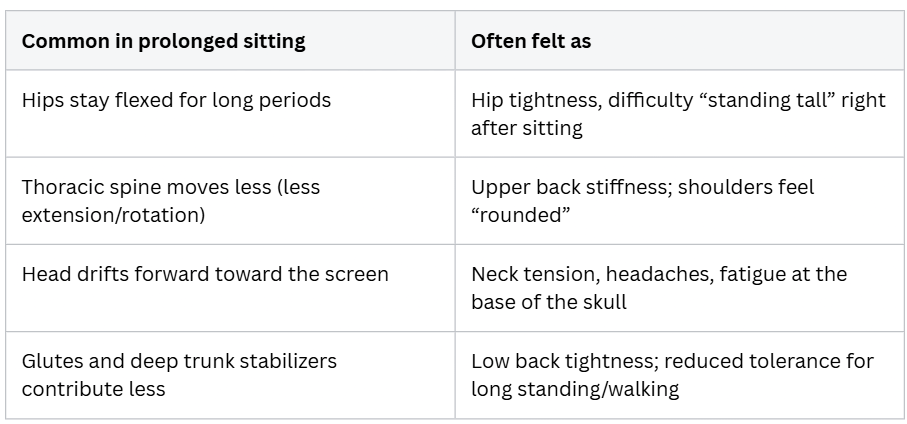
During long sitting periods, hips remain flexed, the trunk often becomes less active, and the head may drift forward toward the screen. Even with a “good” chair, prolonged stillness can increase stiffness and reduce circulation and tissue hydration compared to regular movement.
What people often experience is not a single isolated problem but a stack of small, cumulative changes: reduced hip extension tolerance, decreased thoracic (upper back) mobility, and increased reliance on the neck and shoulder muscles to stabilize the head and arms during keyboard and device use.
Tech Neck
“Tech neck” commonly refers to a forward head position associated with frequent screen use. The head’s weight is constant, but as it moves forward relative to the torso, the neck and upper back muscles may need to work harder to support it. Over time, this can contribute to an overworked posterior neck/upper back and a sense of tightness in the front of the neck and chest.
Typical features — chin pokes forward, upper cervical extension (looking slightly up), and a sense of tension around the upper trapezius/levator area.
Why it happens — sustained forward visual focus, screen positioned too low/far, and limited movement breaks.
Common complaint pattern — neck stiffness after device use, headaches, shoulder/upper back fatigue.
Practical lens — Tech neck is often less about “one wrong posture” and more about how long the head stays forward without frequent resets (standing, looking far, rotating, extending the upper back, and moving the shoulders through full ranges).
Upper Crossed Syndrome
Upper crossed syndrome describes a common pattern in the upper body where some muscles tend to become short/overactive while others become lengthened/underactive. The “cross” concept reflects how the pattern often shows up across the front and back of the upper trunk and neck: the chest and neck flexors may contribute differently than ideal, while the scapular stabilizers and deep neck flexors may contribute less.
This is best understood as a habitual coordination pattern, not a fixed diagnosis. The pattern may change with movement or postural cueing - suggesting that awareness, strength, mobility and environment can all play a role.
Often involved (tend to feel tight/overworked) — upper trapezius, levator scapulae, pectorals (especially with rounded shoulders), and some neck extensors.
Often involved (tend to feel weak/“asleep”) — deep neck flexors, lower trapezius, serratus anterior, and thoracic extensors (varies by person).
Anterior Pelvic Tilt
Anterior pelvic tilt refers to a pelvic position where the front of the pelvis rotates forward and the low back tends to increase its arch (lumbar extension). Some degree of anterior tilt is normal anatomy; the concern is usually when the position becomes stuck or when the person lacks options to move out of it comfortably during standing, walking, lifting, or sport.
Rather than labeling it as “good” or “bad,” it is more useful to ask: Can you control your pelvis and ribs through a range? If not, the body may rely on a narrow strategy, and the low back or hips may take on more stress during daily activities.
Common signs — low back feels tight, ribs flare up, difficulty feeling glutes during hip extension, hamstrings may feel stretched in standing.
Common contributors — prolonged sitting, limited hip extension exposure, high-heel use (some cases), and training that overemphasizes lumbar extension without trunk control.
The Role of the Hip Flexors
The hip flexors (including the iliopsoas group and rectus femoris) keep the hip in flexion and help control the pelvis and spine during movement. During prolonged sitting, these tissues stay in a shortened position for long durations and may become more sensitive or feel “tight.” In some people, the hip flexors also become more dominant because the body relies on them repeatedly for seated posture and for standing up from chairs throughout the day.
Importantly, “tight hip flexors” does not always mean the muscle is simply short. It can also reflect high tone (protective tension), lack of glute contribution, or limited hip extension capacity overall. The goal is often to restore options: hip extension mobility plus strength and control through the trunk and glutes.
What tends to help — short mobility doses (gentle hip extension), glute strengthening, and regular standing/walking breaks to reduce uninterrupted hip flexion time.
The Thoracolumbar Junction and Lumbosacral Junction
The spine is not one uniform structure; different regions have different typical roles. Two transition zones that often matter in posture discussions are the thoracolumbar junction (where the thoracic spine meets the lumbar spine) and the lumbosacral junction (where the lumbar spine meets the sacrum/pelvis).
When movement options above or below are limited (for example, stiff thoracic extension/rotation or limited hip extension), these junctions may take on extra motion and load. Over time, this can contribute to a “pinchy” or tight feeling in the low back, especially during prolonged standing, walking hills, or lifting—because the body is repeatedly borrowing motion from the same transition areas instead of spreading demand across the hips, thoracic spine, and trunk.
Key concept — When the hips and upper back don’t move enough, the mid-to-low back often moves (and works) more than it would prefer.
Why Movement Matters
Movement is the primary way the body maintains options. Frequent, low-intensity position changes can help reduce sustained tissue loading, improve tolerance to sitting and standing, and support circulation and joint nutrition. In many ergonomics and rehabilitation frameworks, the “best posture” is the one you don’t hold for too long.
Think of movement as an investment in your future self. Every time you stand, walk, strengthen your muscles and move through a full range of motion, you help maintain the physical capacity that supports independence as you age.
Practical movement strategies tend to be more effective when they are simple, repeatable, and built into the day rather than treated as a one-time fix.
Change positions often — alternate sitting, standing, and walking when possible; avoid marathon sitting sessions.
Balance the day — include some thoracic extension/rotation, overhead reach, hip extension, and full-range shoulder movement across the week.
Build capacity — combine mobility (range) with strength (control) so new positions feel stable, not forced.
Why Maintaining an Upright Body Matters
One of the noticeable physical changes many people associate with ageing is a gradual shift towards a more flexed posture. The head moves forwards, the shoulders round, the upper back becomes more curved, and walking often becomes slower and less efficient.
While ageing itself contributes to these changes, prolonged inactivity and years of repetitive sitting can encourage similar movement patterns much earlier in life.
As the body gradually adapts to a flexed position, several things may occur:
The muscles responsible for keeping us upright become less active and may lose endurance.
Hip extension becomes more limited, making walking and climbing stairs less efficient.
The thoracic spine may lose extension, affecting shoulder movement and breathing.
Balance can become more challenging because the body's centre of mass shifts forwards.
More muscular effort is required to remain upright, contributing to fatigue during everyday activities.
The goal isn't to maintain a perfectly straight posture. The goal is to preserve your body's ability to extend, rotate, bend, squat, reach and move confidently throughout life.
Key Takeaways
The body adapts to what it practices most — long hours of sitting and screen use can reinforce forward head, rounded shoulder, and hip-flexed patterns.
Prolonged sitting is a duration problem — even an “ideal” setup can become a problem when the position is held too long without movement breaks.
Tech neck and upper crossed syndrome are often coordination patterns — they reflect how the head, ribs, shoulders, and upper back are working together, not a single muscle issue.
Anterior pelvic tilt is about options and control — some tilt is normal; issues arise when you cannot move comfortably out of the pattern or when the low back takes on too much work.
Hip flexors are not the enemy — they are essential muscles that can feel tight or overworked when hips stay flexed for long periods and glutes/trunk contribute less.
Transition zones matter — when the hips and upper back move less, the thoracolumbar and lumbosacral junctions may compensate and feel strained.
Movement variety is a reliable intervention — frequent position changes plus basic mobility and strength work tends to outperform chasing “perfect posture.”
References
Chen X, Coombes BK, Sjøgaard G, Jun D, O’Leary S, Johnston V. Workplace-based interventions for neck pain in office workers: systematic review and meta-analysis. Physical Therapy. 2018;98(1):40–62. doi:10.1093/ptj/pzx101.
Garber CE, Blissmer B, Deschenes MR, et al. American College of Sports Medicine position stand. Quantity and quality of exercise for developing and maintaining cardiorespiratory, musculoskeletal, and neuromotor fitness in apparently healthy adults: guidance for prescribing exercise. Medicine & Science in Sports & Exercise. 2011;43(7):1334–1359. doi:10.1249/MSS.0b013e318213fefb.
Jun D, Zoe M, Johnston V, O’Leary S. Physical risk factors for developing non-specific neck pain in office workers: a systematic review and meta-analysis. International Archives of Occupational and Environmental Health. 2017;90(5):373–410. doi:10.1007/s00420-017-1205-3.
National Institute for Occupational Safety and Health (NIOSH) / Centers for Disease Control and Prevention (CDC). Ergonomics resources on computer workstation setup and musculoskeletal risk reduction.
World Health Organization. WHO Guidelines on Physical Activity and Sedentary Behaviour. Geneva: World Health Organization; 2020.
This article provides general health and educational information and is not intended to replace individual assessment, diagnosis, or treatment by a qualified healthcare professional.