Breastfeeding and Latching

Breastfeeding is a natural process, but it does not always come naturally.
In the early days, many mothers and babies experience challenges with positioning, latching, or milk transfer. While these difficulties can be frustrating, they are often temporary and can improve with the right support and practical strategies.
This article explores common breastfeeding and latching challenges, explains why they occur, and outlines evidence-based approaches to help mothers feed more comfortably and confidently.
Gentle reminder — If something feels painful or stressful, pause and reset. Small adjustments can make a big difference.
1. Signs of Poor Latch and Symptoms
You may notice one or more of the following (especially early on). Any single sign can be normal at times, but patterns are worth addressing.
Baby frequently unlatches or slides off the breast
Nipple pain, cracking, or bleeding
Clicking sounds while feeding
Very long feeds or poor weight gain
Gassiness, reflux, or fussiness after feeds
Nipple looks flattened, blanched, or “lipstick-shaped” after feeding
2. How to Achieve a Good Latch
Use these steps each time you latch—especially if you feel pinching pain or hear clicking.
Bring your baby close: hold their whole body tummy-to-tummy with you (chest-to-chest), aligned and supported.
Line up nose and head: keep your baby’s nose at nipple level and tip their head slightly back so the top lip can brush the nipple.
Wait for a wide mouth: gently brush the nipple across the upper lip, then bring baby to breast chin first when the mouth opens wide.
Check for a deep latch: aim the nipple toward the roof of the mouth. You should see more areola above the top lip than below the bottom lip, with lips flanged outward and cheeks full/rounded.
Note — A good latch should feel like strong tugging, not sharp pain. If it hurts beyond the first moments, gently break the suction with a clean finger and re-latch.
3. Positioning Techniques
Try a few positions to find what feels most comfortable for you and helps your baby latch deeply.
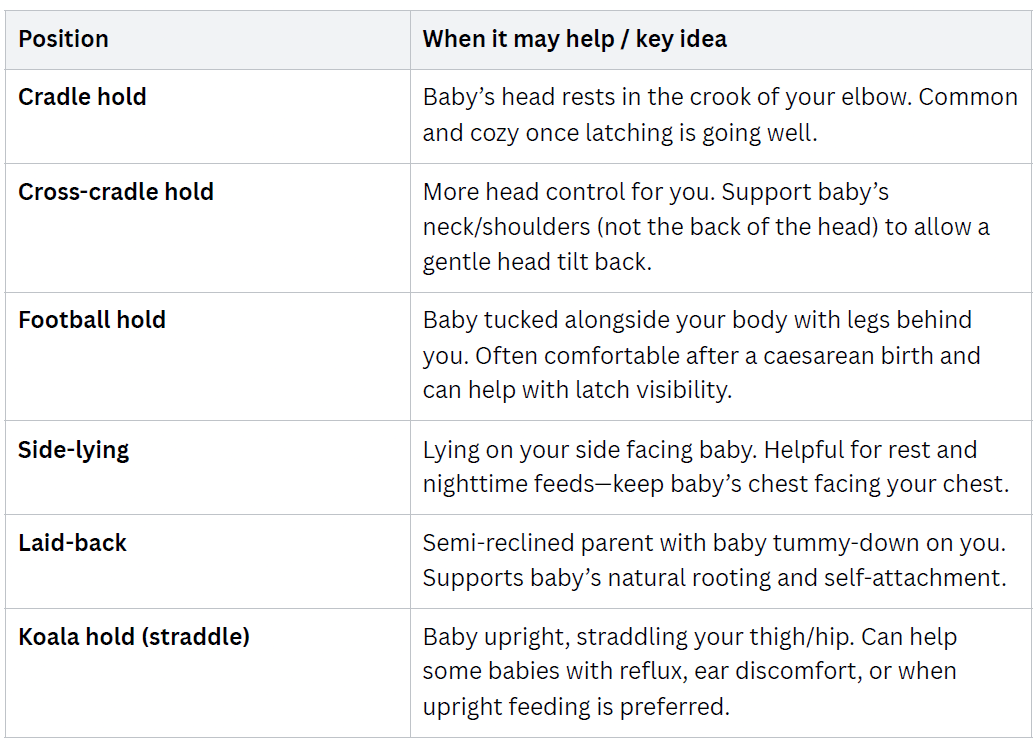
Caution — Never fall asleep with your baby on a sofa or armchair. This significantly increases the risk of sudden infant death syndrome (SIDS). If you might doze during feeds, plan for a safer setup and talk with your healthcare provider.
4. Solutions for Fast Let-Down
If milk flow feels very strong at the start (baby coughs, gulps, clicks, or pulls off), try:
Express a small amount first (hand express or pump briefly) to reduce the initial surge.
Feed in a reclined position (laid-back or side-lying) so gravity slows the flow.
Burp more often during feeds to reduce swallowed air.
Use gentle breast compressions only as needed—pause if it increases flow too much.
5. Inverted or Flat Nipples
Many babies can breastfeed well with inverted or flat nipples, but it may take extra patience and positioning.
Stimulate before latching (hand expression, gentle rolling, or brief pumping) to evert the nipple.
Focus on latch depth: baby needs a mouthful of breast tissue, not just the nipple.
Consider a nipple shield as a temporary tool—use with guidance from a lactation professional when possible.
Tip — The “flipple” (exaggerated latch) technique can help: shape the breast, aim nipple toward the roof of the mouth, then bring baby in chin-first for a deeper latch.
6. Baby’s Oral Restrictions (Tongue/Lip Tie)
Some babies have oral restrictions that affect latch and milk transfer. Common signs include:
Shallow latch, clicking, or frequent slipping off
Baby tires quickly, falls asleep often at the breast, or feeds very frequently
Ongoing nipple pain or damage despite good positioning
What can help:
Seek assessment from a lactation consultant and your baby’s clinician (some families are referred to a pediatric dentist/ENT for evaluation).
Try laid-back or other positions that support a deeper latch.
If a release procedure is recommended, follow aftercare guidance (stretches/exercises) as directed by your care team.
7. Alternate Feeding Methods When Breastfeeding Is Challenging
If breastfeeding is temporarily difficult, protecting milk supply and keeping baby fed are both important. Options may include:
Pumped breast milk by bottle (paced feeding can help reduce flow preference)
Cup feeding (in appropriate situations and with guidance)
Finger feeding with a supplemental nursing system (SNS)
Short-term syringe or spoon feeds when advised
Combination feeding under supervision when needed for growth or supply
Supportive note — Needing supplementation at times is common and not a failure. With the right plan, many families return to comfortable breastfeeding.
8. When to Seek Help
Reach out to your healthcare provider, lactation consultant, or your baby’s clinician if you notice:
Severe or worsening nipple pain, cracks, bleeding, or signs of infection (fever, red hot area on the breast)
Baby is not gaining weight well, seems consistently unsatisfied, or feeds are extremely long and frequent
Fewer wet diapers than expected for age, very dark urine, or persistent sleepiness during feeds
Concern for tongue/lip tie or other oral restriction affecting feeding
Low milk supply concerns despite frequent effective milk removal
Closing reassurance
Breastfeeding is a learned skill for both you and your baby. If it isn’t comfortable yet, you’re not alone—small, supported adjustments can lead to big improvements. The right help at the right time can make feeding safer, easier, and more enjoyable for you both.
References
Academy of Breastfeeding Medicine. (2021). ABM Clinical Protocol #26: Persistent Pain with Breastfeeding. Breastfeeding Medicine, 16(5), 353–360.
Academy of Breastfeeding Medicine. (2022). ABM Position Statement on Ankyloglossia in Breastfeeding Dyads. Breastfeeding Medicine, 17(4), 278–281.
American Academy of Pediatrics. (2022). Policy Statement: Breastfeeding and the Use of Human Milk. Pediatrics, 150(6), e2022057988.
World Health Organization. (2023). Infant and Young Child Feeding. Geneva: World Health Organization.
UNICEF. (2023). Breastfeeding: A Mother's Guide. New York: UNICEF.
Lawrence, R. A., & Lawrence, R. M. (2022). Breastfeeding: A Guide for the Medical Profession (9th ed.). Elsevier.
Riordan, J., & Wambach, K. (2022). Breastfeeding and Human Lactation (6th ed.). Jones & Bartlett Learning.
Newman, J., & Pitman, T. (2014). Dr. Jack Newman's Guide to Breastfeeding (Revised ed.). HarperCollins Canada. (Reference for the Flipple/exaggerated latch technique.)
South Tees Hospitals NHS Foundation Trust. (2024). Breastfeeding Self-Help: Exaggerated Latch (Flipple) Technique.
Hazelbaker, A. K. (2017). The Assessment Tool for Lingual Frenulum Function (ATLFF/HATLFF). (For tongue-tie assessment).