Head Shapes in Babies

Understanding positional plagiocephaly, brachycephaly and why early movement matters.
A flat spot on your baby's head can be worrying, but in most cases it reflects how babies move and spend time during the first months of life rather than a problem with brain growth.
Concern about “flat spots” on babies’ heads has increased over the last three decades. This trend has occurred alongside the success of the Back to Sleep campaign, which significantly reduced the risk of sudden infant death syndrome (SIDS) by encouraging babies to sleep on their backs.
While this public health message has saved lives, it has also been associated with a rise in positional head shape changes, especially positional plagiocephaly (asymmetry) and brachycephaly (a wider, flatter back of the head). For many families, the key question becomes: are these changes “just cosmetic,” or can they reflect broader patterns in early movement and development?
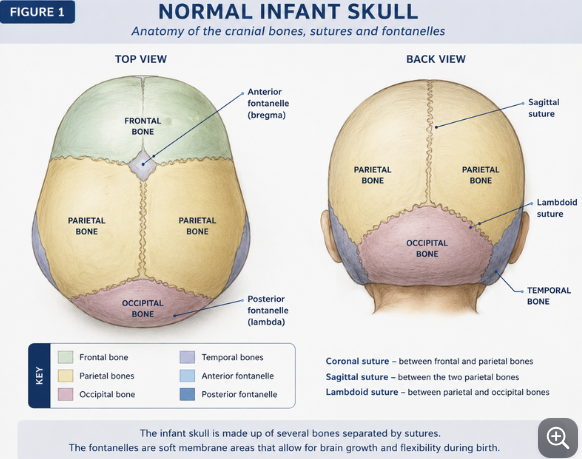
Figure 1. Anatomy of the infant skull showing the major cranial bones, sutures, and fontanelles. The flexible sutures and open fontanelles allow rapid brain growth during infancy while permitting slight moulding of the skull. These same characteristics also make the infant skull susceptible to positional head shape changes when external pressure is prolonged.
Understanding Positional Head Shape
A baby’s skull is designed to be flexible. The bones are connected by sutures and separated by soft spots called fontanelles, which help the head mould during birth and allow rapid brain growth in the first years of life.
Because the skull is still forming, prolonged pressure in one area can gradually change head shape. This is most likely when a baby spends a lot of time resting with the head in the same position.
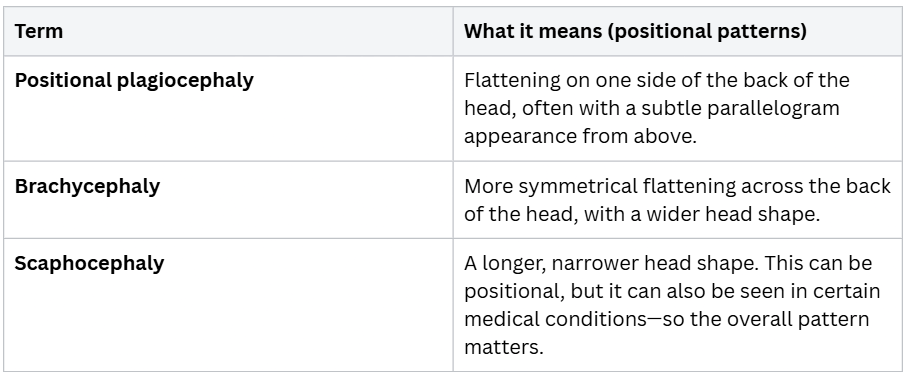
It’s important to distinguish positional head shape changes from craniosynostosis, where one or more skull sutures fuse early. Craniosynostosis is less common and requires specialist assessment because it changes skull growth patterns differently and may need medical or surgical management.
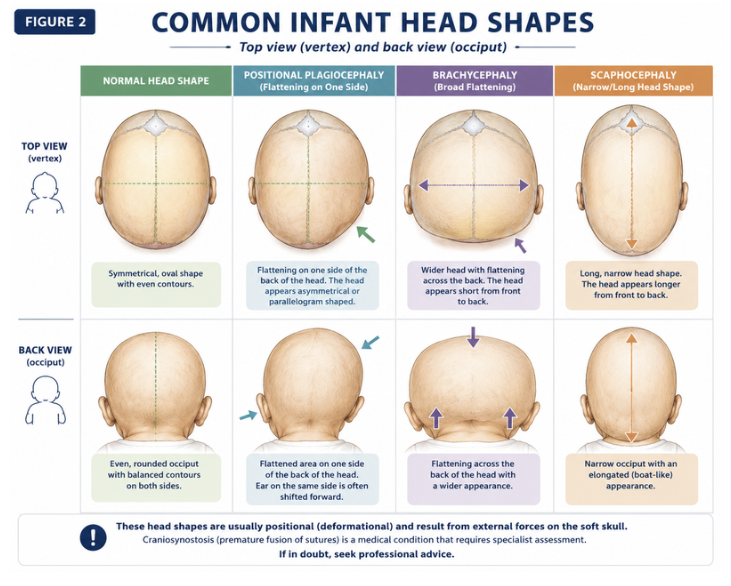
Figure 2. Typical infant head shapes seen in clinical practice. The top row shows the head from above ( vertex view), while the bottom row shows the back of the head (occipital view). Understanding these characteristic patterns helps distinguish normal variation from positional head shape changes and conditions requiring further medical evaluation.
Clinical note — If the head shape looks unusual, is rapidly changing, or doesn’t fit a typical positional pattern, arrange timely specialist review to rule out craniosynostosis.
Why Does Head Shape Change?
In most cases, head shape changes reflect movement patterns and a baby’s daily environment rather than a primary skull problem. If a baby tends to rest or play with the head turned the same way (or spends long periods supported in reclined equipment), pressure is repeated in the same area and the head can gradually flatten.
Common contributing factors include:
Head preference — consistently turning to one side when resting or playing.
Tight neck muscles, including congenital muscular torticollis (a neck muscle imbalance that makes turning or tilting easier in one direction).
Prematurity — softer skulls, more time lying down, and less energy for active movement early on.
Reduced tummy time while awake and supervised (less time working against gravity).
Long periods in car seats, swings, bouncers, and reclined equipment (pressure plus less opportunity for free movement).
Limited floor movement and fewer chances to explore different positions.
Feeding or carrying in the same position most of the time (reinforcing a preferred head turn).
This is sometimes described as the “container baby” phenomenon: when a baby spends many hours supported by devices, there may be less time for natural, variable movement that builds symmetry and strength.
Is It Only Cosmetic?
Most babies with positional plagiocephaly have normal brain growth, and current evidence does not support the idea that the skull is routinely compressing the brain or causing routine brain injury in typical positional cases.
At the same time, research has found that babies with plagiocephaly are more likely to show early motor delays. Importantly, this association does not prove that the flat spot causes the delay. A helpful way to think about this is that plagiocephaly may be a marker—a visible sign that a baby has had less variety in movement, prefers one direction, or is finding certain positions harder.
Takeaway — Positional head shape changes are often a clue to look more closely at comfort, symmetry, and movement opportunities—not a reason to panic.
Looking Beyond the Skull
Whether you’re a clinician or a parent, it helps to assess movement, posture, and development—not head shape alone. The goal is to understand how the baby is using their body throughout the day and whether they can move comfortably in multiple directions.
Rather than asking only "How flat is the head?", clinicians should ask "Why did this pattern develop?"
Helpful questions to guide observation include:
Turning both ways — Can the baby turn the head left and right with similar ease?
Tummy time head control — During supervised tummy time, can the baby lift the head and rotate to look both directions?
Hand use — Are both hands used equally for reaching and bringing hands to mouth?
Feeding comfort — Is the baby comfortable feeding on both sides (breast or bottle), without obvious struggle in one position?
Resting habits — Does the baby tend to rest in the same head position every time (sleep, pram, play mat)?
Milestone quality — Are milestones emerging with smooth, coordinated movement (not just “can they do it,” but how they do it)?
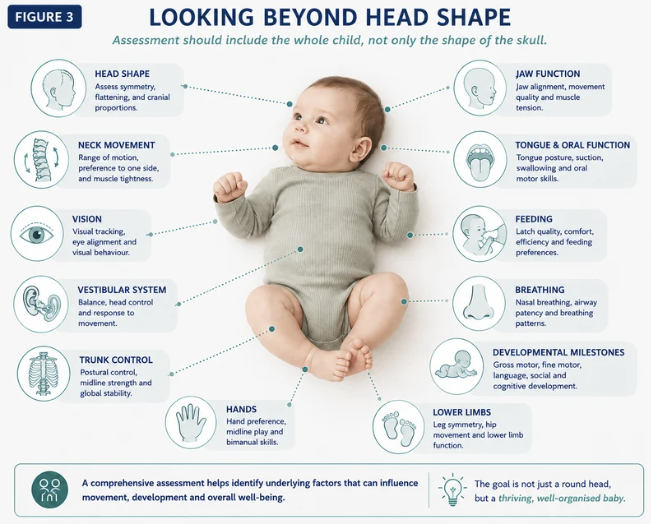
Figure 3. A comprehensive infant assessment extends beyond cranial symmetry to evaluate movement, posture, feeding, oral function, airway, sensory systems, and developmental milestones, helping identify underlying contributors to optimise function, development, and overall well-being.
Rather than viewing positional head shape as an isolated skull problem, it can be helpful to view it as a visible marker of an infant's overall movement organisation. Movement organisation refers to how a baby uses their body—coordinating posture, movement, balance, and interaction with their environment during everyday activities. Head shape develops within a broader system that includes posture, interaction with gravity, movement variability, sensory experiences, feeding, and the environment. Assessing these factors may help identify why a head shape pattern developed and guide more comprehensive management.
Head Shape, Feeding and Facial Development
The skull, neck, jaw, and tongue function as an integrated system. When a baby has a persistent head preference, it can influence feeding posture and how the jaw and oral muscles work during sucking, swallowing, and breathing-related patterns.
For example, always turning to one side may change how a baby stabilizes through the neck and shoulders, which can subtly affect jaw movement and oral muscle activity during feeds. Researchers are also exploring possible links between head/neck posture and factors such as tongue posture, breathing patterns, and longer-term facial growth.
It’s important to keep this balanced: many aspects are still under investigation, and not every baby with head shape differences will go on to have later feeding, breathing, or facial development concerns. Still, the head–neck–mouth connection is one reason a whole-body assessment can be useful when head shape concerns arise. Although these relationships are still being studied, clinicians should consider feeding and oral function as part of a comprehensive assessment rather than assuming head shape alone explains feeding difficulties.
Supporting Healthy Development
The most helpful strategies are usually simple and consistent—focused on varied positions, symmetry, and active movement throughout the day.
Supervised tummy time (awake) — start small and build up; aim for frequent short sessions.
Alternate feeding and carrying positions — switch sides and angles to avoid reinforcing one head turn.
Encourage active head turning both ways — use voice, toys, and positioning to invite looking to the non-preferred side.
Reduce unnecessary time in containers — limit long stretches in car seats (when not travelling), swings, bouncers, and reclined loungers.
Prioritize varied floor play — provide safe space for free movement and exploration on a firm surface.
Assess and manage neck tightness — seek physiotherapy or specialist guidance when there is head preference, limited range, or suspected torticollis.
In selected cases, helmet therapy may be recommended—typically when flattening is more significant and does not improve with repositioning and movement support, or when identified later. This decision is best made with appropriately trained clinicians and clear, individualized guidance.
A Whole-Baby Perspective
Head shape is neither “just cosmetic” nor proof of developmental impairment. It’s best understood as one piece of a bigger picture: how the baby is moving, exploring, and interacting with the world.
Healthy development depends on:
Varied movement across positions (back, side, tummy, supported upright when appropriate).
Sensory experiences that invite turning, reaching, and looking both ways.
Opportunities to work against gravity (especially during supervised tummy time and active play).
Integrated body organisation—comfortable coordination across head, neck, trunk, and limbs.
When Should You Seek An Assessment?
Consider having your baby assessed if you notice:
A head preference that persists beyond the first few weeks of life.
Difficulty turning the head equally to both sides.
A flat spot that continues to worsen despite repositioning and tummy time.
Delayed motor milestones or concerns about movement quality.
Feeding difficulties, persistent side preference during feeding, or jaw asymmetry.
An unusual head shape present from birth or one that changes rapidly.
Concerns about a ridge along the skull or an unusual skull shape, as these may require assessment to exclude craniosynostosis.
A comprehensive assessment looks at head shape alongside movement, posture, neck function, feeding, and overall development to guide the most appropriate management.
Key Message
A flat spot does not necessarily mean a baby will have developmental problems—but it also shouldn’t be dismissed as “only cosmetic” without considering movement, posture, feeding, neck function, and overall development. When we look beyond head shape, we gain a better understanding of the whole child.
With early recognition, thoughtful assessment, and supportive interventions when needed, many babies can improve comfort, symmetry, and skills. The goal is not simply a well-shaped skull—it is a well-organised child who can move, explore, learn, and thrive.
References
Argenta, L., David, L., & Thompson, J. (2004). Clinical classification of deformational plagiocephaly. Journal of Craniofacial Surgery, 15(3), 368–372.
American Academy of Pediatrics. (2020). Back to Sleep, Tummy to Play. (Safe sleep and prevention recommendations.)
Collett, B. R., Gray, K. E., Wallace, E. R., et al. (2019). Development at age 36 months in children with and without deformational plagiocephaly. Pediatrics.
Collett, B. R., Breiger, D., King, D., Cunningham, M., & Speltz, M. L. (2005). Neurodevelopmental implications of deformational plagiocephaly. Journal of Developmental & Behavioral Pediatrics.
Collett, B. R., et al. (2013). Development in toddlers with and without deformational plagiocephaly. Archives of Pediatrics & Adolescent Medicine.
Laughlin, J., Luerssen, T., & Dias, M. (2011). Prevention and management of positional skull deformities in infants. Pediatrics, 128(6), 1236–1241.
Pastor-Pons, I., et al. (2021). Manual therapy in infants with positional plagiocephaly: A randomized controlled trial. Children, 8(4), 316.
Pastor-Pons, I., et al. (2023). Manual therapy and caregiver education in positional plagiocephaly: Follow-up outcomes. Children.
Van Vlimmeren, L. A., et al. (2007). Risk factors for deformational plagiocephaly at birth and at seven weeks of age. Pediatrics.
Hutchison, B. L., Stewart, A. W., & Mitchell, E. A. (2004). Characteristics, head shape measurements and developmental delay in infants with deformational plagiocephaly. Developmental Medicine & Child Neurology.
Moss, S. D. (1997). Nonsurgical, nonorthotic treatment of occipital plagiocephaly. Journal of Neurosurgery.
Wilbrand, J. F., et al. (2017). Value and limitations of helmet therapy for positional plagiocephaly. Journal of Cranio-Maxillofacial Surgery.
Moss, M. L. Functional Matrix Theory of Craniofacial Growth. (Foundational theory for craniofacial development.)
Proffit, W. R., Fields, H. W., & Sarver, D. M. Contemporary Orthodontics.