The Body As a System of Adaptation: Understanding Why Posture Changes
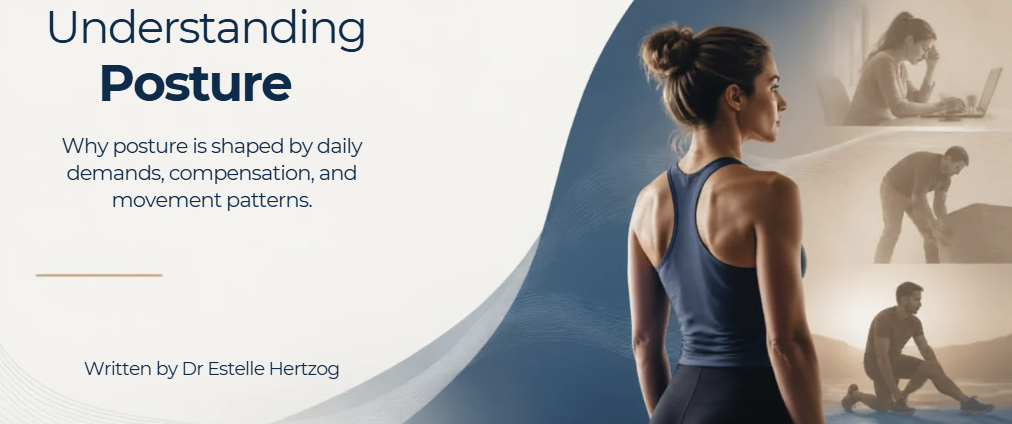
Posture isn’t a fixed “shape” your body should hold—it’s the outcome of how your body adapts to the demands you place on it every day.
If you’ve noticed changes like a forward head position, rounded shoulders, or stiffness through your upper back, it’s rarely because your body is “failing.” More often, it’s because your system is doing what it’s designed to do: keep you upright, stable, and functioning—especially under repeated stress and constant gravity.
Posture Reflects Adaptation, Not a Moral Failing
Your posture reflects what your body has learned is the most efficient way to meet your current needs—work, sport, daily habits, fatigue levels, and even how safe or stable you feel.
When the body senses a challenge (heavy workload, prolonged sitting, limited movement variety, discomfort, stress, or weakness in certain areas), it reorganizes. That reorganization is adaptation: a practical solution based on the options your body has available.
Key idea — Compensation isn’t inherently “bad.” It’s a normal survival strategy your body uses to keep you balanced, mobile, and protected when conditions demand it.
Compensation becomes a problem only when it’s the only strategy available—used so often that other movement options become less accessible over time.
Gravity Is Always Training You (Whether You Notice It or Not)
Gravity constantly affects your balance. Even when you’re “still,” your body is making small, ongoing adjustments to keep you upright.
When posture changes, your centre of gravity shifts. To prevent you from tipping forward, backward, or sideways, the body redistributes effort across muscles and joints. That redistribution is often subtle at first—and then becomes your new default if the demand is repeated frequently enough.
For example, if your head and upper torso drift forward, other regions may respond to keep you standing and seeing straight ahead. The body prioritizes stability and function in the moment, not perfect alignment on a checklist.
How Repeated Demands Create Common Postural Patterns
Your body adapts to what it does most. When the same positions and tasks are repeated (hours at a screen, driving, certain training styles, or working with arms in front of you), your system gets very good at those patterns—and less practiced at the alternatives.
Over time, repeated demands can contribute to changes such as:
Forward head posture — the head sits farther forward relative to the torso as the body finds a stable way to orient the eyes and balance the load of the head.
Rounded shoulders — the shoulders rest more forward, often paired with less variability in shoulder blade movement.
Reduced upper-back (thoracic) movement — the upper back may move less, especially into extension and rotation, which can shift work to nearby regions.
Shortened chest muscles — the front of the chest may become more accustomed to a shortened position when the shoulders live forward most of the day.
Reduced neck-and-shoulder endurance — the neck and shoulder muscles may fatigue sooner if they’re regularly asked to “hold you up” in a limited set of positions.
These changes don’t prove something is wrong with you—they show your body has adapted to repeated inputs. The key is understanding that adaptation can be updated when you introduce new options and workloads.
Compensation Is Whole-Body: One Change Can Ripple Everywhere
Postural compensation rarely stays in one place. When one area becomes less mobile or less resilient, the body often borrows motion or stability elsewhere to keep you moving and upright.
That can influence multiple regions, including the:
Thoracic spine — changes in upper-back movement can affect how the ribcage sits and rotates.
Shoulders — altered shoulder position and control may show up during reaching, lifting, or overhead work.
Hips — shifts in pelvic position or load sharing can change how the hips extend, rotate, or stabilize.
Lower back — it may take on extra movement or tension if the hips or thoracic spine aren’t contributing as much.
Knees — they can be affected by how the hips and pelvis control alignment under load.
Pelvis — a central “bridge” that often adapts based on breathing strategy, hip mobility, and spinal movement options.
One reason these patterns persist is that the nervous system learns repeated movement strategies. The more often a pattern is used, the more efficient and automatic it becomes. That’s helpful for survival and daily life—but it also means your body can become “specialized” in a narrower set of options.
Conclusion: Better Posture Comes From More Options, Not Perfect Stillness
Improving posture isn’t about forcing a rigid “correct” position all day. It’s about expanding your movement choices so your body has multiple ways to handle gravity, tasks, and fatigue.
When you increase mobility where it’s limited, build endurance where it’s needed, and practice varied patterns, your system becomes more adaptable—so posture can change naturally in a healthier direction without constant self-correction.
Key Takeaways
Posture is adaptive. It reflects how your body responds to repeated demands and the need to stay balanced under gravity.
Compensation is normal. It’s a survival strategy—problematic mainly when it becomes your only strategy.
Gravity drives constant adjustment. As posture shifts, your centre of gravity shifts—and the body redistributes effort to keep you upright.
Repeated patterns shape tissues and endurance. Forward head posture, rounded shoulders, reduced upper-back movement, shortened chest muscles, and reduced neck-and-shoulder endurance can all emerge from what you do most.
Changes can ripple through the whole body. Compensation may affect the thoracic spine, shoulders, hips, lower back, knees, and pelvis.
Lasting change is a learning process. The nervous system reinforces repeated movement patterns—so improvement comes from practicing new ones consistently.
Aim for more movement options. The goal is adaptability, not chasing perfect alignment.
References
American Physical Therapy Association. Clinical Practice Guidelines for musculoskeletal conditions.
Cramer GD, Darby SA. Clinical Anatomy of the Spine, Spinal Cord, and ANS. 3rd ed. Elsevier; 2014.
Hodges PW, Tucker K. Moving differently in pain: A new theory to explain the adaptation to pain. Pain. 2011;152(3 Suppl):S90–S98.
Latash ML. Fundamentals of Motor Control. Academic Press; 2012.
Lederman E. The fall of the postural-structural-biomechanical model in manual and physical therapies: Exemplified by lower back pain. Journal of Bodywork and Movement Therapies. 2011;15(2):131–138.
Myers TW. Anatomy Trains: Myofascial Meridians for Manual and Movement Therapists. 4th ed. Elsevier; 2020.
Neumann DA.Kinesiology of the Musculoskeletal System: Foundations for Rehabilitation. 3rd ed. Elsevier; 2017.
Shumway-Cook A, Woollacott MH. Motor Control: Translating Research into Clinical Practice. 6th ed. Wolters Kluwer; 2021.
Slater D, Korakakis V, O'Sullivan P, Nolan D, O'Sullivan K. “Sit Up Straight”: Time to Re-evaluate. Journal of Orthopaedic & Sports Physical Therapy. 2019;49(8):562–564.
Winter DA. Biomechanics and Motor Control of Human Movement. 4th ed. Wiley; 2009.
This article provides general educational information about posture, movement and adaptation. It is not intended to diagnose or treat any condition and does not replace an individual assessment by a qualified healthcare professional.