Understanding Pulling to Stand: When Your Baby Discovers Upright
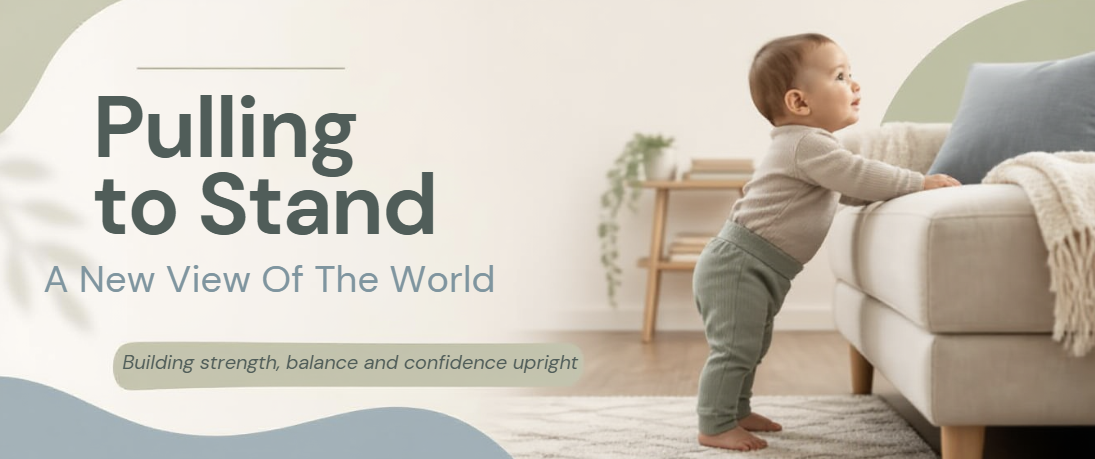
When the world suddenly becomes taller.
One day, your baby’s familiar floor-level view begins to change. A reach becomes a pull, a shift of weight becomes a rise, and suddenly the room looks different from above.
Pulling to stand is more than getting upright. It is a whole-body discovery that brings balance, strength, coordination, problem-solving, and curiosity together. This article explores what may be happening as your baby experiments with standing, moving, lowering, and eventually letting go—without turning development into a race or a performance. Pulling to stand: a new view of the world.
The movement may look smooth one day and effortful the next. Your baby may pause, bend their knees, lower back down, or try again from a different position. These moments are part of the exploration: upright movement is not one single action, but a series of small discoveries.
Why pulling to stand matters
Pulling to stand gives your baby a new way to interact with the world. Upright, they can see father, reach towards different objects and, explore possibilities that were less accessible from the floor.
It also connects earlier movement experiences with new ones. Reaching, rolling, sitting, crawling, shifting between positions, and standing are not isolated achievements. They can overlap and support one another as your baby develops more ways to move and explore.
Key idea
Pulling to stand is an invitation to explore a new perspective—not a test your baby needs to pass on a schedule.
The whole-body skills involved
Although the hands may be the most visible part of the movement, pulling to stand involves the whole body. Your baby is coordinating the legs and hips to press into the floor, the trunk to stay organized, and the shoulders and arms to reach for a stable point of contact.
The hands provide information as well as support. They help your baby feel whether a surface is close, firm, high, or within reach. At the same time, the eyes are taking in the changing view, while the brain is continually adjusting the body’s position in response to movement and balance.
These skills are connected to body awareness and motor planning: sensing where the body is, deciding what to try next, and adapting when the first attempt does not work. Wobbling, pausing, changing direction, and trying again can all be part of that learning process.
How babies get up
A sequence, not a single move
Babies may begin from several positions. Some move from sitting toward their hands and knees, bring one foot forward, and press upward. Others use a low surface to shift their weight, pull with their arms, and gradually straighten through the legs. The route can look deliberate one day and improvised the next.
The movement is rarely smooth at first. Your baby may pause halfway, lean heavily into the support, drop back down, or change the position of their hands and feet. Each attempt offers information about balance, leverage, distance, and what their body can do in that moment.
What parents may notice
There is no single visual script for pulling to stand. You may see a wide range of strategies, including repeated attempts, brief pauses, uneven weight shifts, and sudden changes in approach. The table below pairs common observations with possibilities that may help make the movement easier to understand.
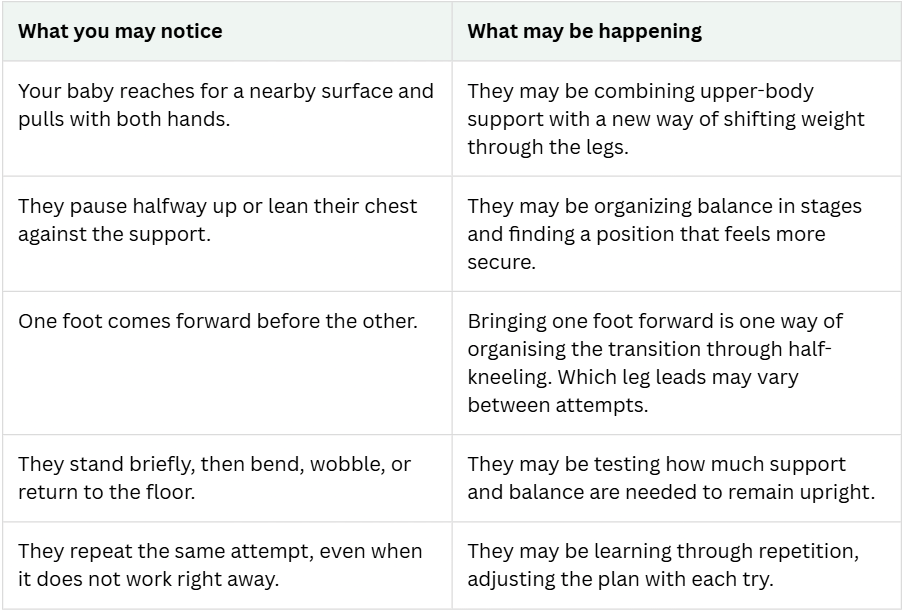
What looks like effort, hesitation, or repetition is often part of the discovery. Your baby is not simply trying to “get it right”; they are gathering information and adapting their movement as they go.
Getting back down
Standing up is only one part of the challenge. Returning to the floor requires a different kind of control because your baby must bend, lower their weight, and decide where to place their hands or body next. The way down may be slow and careful, or it may happen as a sudden plop when the legs tire or balance shifts.
Over time, your baby may begin to lower with more intention. They may bend their knees, turn toward the support, or move through another familiar position before settling on the floor. These transitions show that upright movement is connected to the rest of the movement landscape, rather than being a separate skill.
Asymmetry and variation
Many babies show a preference in how they begin. One hand may reach first, one leg may step forward more often, or the body may turn more easily in one direction. A single attempt can look uneven simply because your baby is exploring one possible strategy.
Variation is part of the developmental picture. Babies differ in their body proportions, experiences, energy, temperament, opportunities to move, and ways of solving the same problem. Looking at the broader pattern—how your baby explores, adapts, and returns to movement over time—can be more informative than judging one moment or one side in isolation.
What is more useful to notice is a pattern that persists over time. For example, a baby may consistently lead with only one leg, avoid taking weight through one side, or rarely explore movement towards one direction. A repeated difference that remains noticeable acrosss several movements is worth discussing with your child’s healthcare professional.
Feet, balance and the new upright base
Standing also changes the job of the feet. During floor movement they have been relatively free, but now they become part of your baby’s base of support. As weight shifts forward, backward and from side to side, the feet and ankles help the body respond to small changes in balance.
On a safe surface, time barefoot allows the feet to move freely and gives your baby sensory information about the surface underneath them. There is no need to position the feet or practice a “perfect” stance. Standing, shifting weight and making small adjustments are themselves part of learning to balance.
Moving from holding on to letting go
At first, the support may be the central feature of standing. Both hands can stay firmly connected while your baby focuses on keeping the body upright. Later, they may shift one hand, turn the torso, reach toward an object, or briefly test what happens when the grip becomes lighter.
Letting go is not a switch that flips all at once. It can begin with a momentary release, a change in hand position, or a reach toward something interesting. Your baby may return to holding on immediately, then try again in a different situation. These small experiments help connect balance with confidence while keeping the movement responsive and self-directed.
Notice the process
A brief release, a wobble, or a return to support can all be meaningful parts of learning. The goal is not to make the movement happen, but to give your baby room to explore it.
Safe exploration
As your baby becomes more mobile, a clear and supervised space becomes increasingly valuable. Keep the area free of avoidable obstacles, and make sure the surfaces your baby is likely to use for support are stable and do not slide or tip easily. Pay attention to edges, cords, small objects, and anything that could become reachable from a standing position.
Stay close enough to respond while allowing your baby to do the experimenting. Support does not have to mean directing every movement. A calm presence, time to try, and a thoughtfully arranged environment can make exploration feel both protected and genuinely theirs.
Cruising: moving while holding on
Once standing is becoming familiar, your baby may begin to move sideways while holding onto furniture or another support. This is often called cruising. It asks for a new combination of skills: shifting weight from one leg to the other, moving the feet in sequence, coordinating the hands with the lower body, and deciding where to go next.
Cruising may look like a series of tiny side steps, a sideways shuffle, or a turn back toward a more familiar position. Your baby may travel only a short distance before pausing, lowering down, or changing direction. Each movement can help them learn how support, balance, and distance work together.
The furniture is not just something to hold. It becomes part of a changing route through the room. Your baby may move between nearby points of support, reach around an object, or pause to investigate something along the way. The pace and pattern can vary from one exploration session to another.
What comes next
As upright movement becomes more familiar, your baby may combine standing with reaching, turning, lowering, and moving between supports. They may spend time practicing one transition before showing interest in another. Some explorations may look like progress, while others may look like a return to an earlier position; both can be part of building a flexible movement vocabulary.
Independent steps may eventually become one way your baby moves through the world, but there is no need to frame every attempt as a countdown to walking. The important story is the growing ability to notice, adapt, and choose among different ways of getting somewhere. Floor movement, supported standing, cruising, and free movement can all have a place in that story.
A changing relationship with movement
Your baby is learning more than how to stand. They are learning how their body relates to surfaces, space, objects, and other people. They are discovering that a new position can offer a new view, that balance can change, and that a movement can be adjusted when the first plan does not work.
Offer a safe space, stay attentive, and let your baby’s curiosity lead. Development is a process of exploration, adaptation, and increasingly confident movement.
References
Adolph KE, Berger SE. Motor development. In: Kuhn D, Siegler RS, Damon W, Lerner RM, eds. Handbook of Child Psychology: Cognition, Perception, and Language. 6th ed. Wiley; 2006.
Adolph KE, Hoch JE. Motor development: embodied, embedded, enculturated, and enabling. Annual Review of Psychology. 2019;70:141–164.
American Academy of Pediatrics. Shoes for Children: A Review.Pediatrics.
Centers for Disease Control and Prevention. Milestones by 1 Year: Learn the Signs. Act Early.
Hadders-Algra M. Variation and variability: key words in human motor development. Physical Therapy. 2010;90(12):1823–1837.
World Health Organization Multicentre Growth Reference Study Group. WHO Motor Development Study: windows of achievement for six gross motor development milestones. Acta Paediatrica Supplement. 2006;450:86–95.
This article provides general developmental information. Individual variation exists, and a movement pattern alone does not diagnose a musculoskeletal or neurological condition. The information provided does not replace an individual assessment by your child's healthcare professional.