Understanding Crawling: More Than Getting From A to B
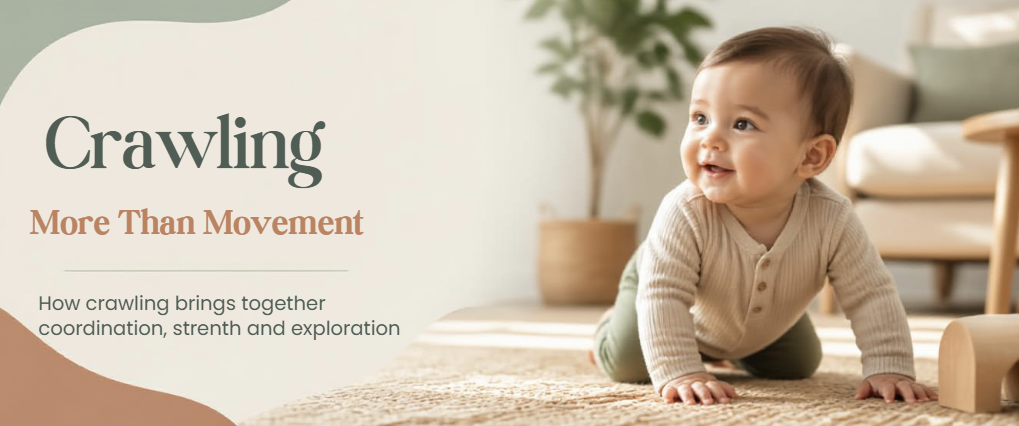
When your baby discovers independent movement
There is often a moment before crawling begins when you can almost see the problem your baby is trying to solve.
The toy is over there.
Your baby can see it.
They can reach towards it.
But they can't quite get there.
So they start experimenting.
They stretch.
Pivot.
Push backwards.
Rock.
Drag themselves forwards.
And eventually they discover something extraordinary:
They can move themselves through space.
Crawling represents a major change in development because your baby is no longer simply learning to control different positions.
They are beginning to connect those positions into independent mobility.
But crawling is about much more than getting from one side of the room to the other.
The way your baby crawls brings together weight bearing, balance, rotation, trunk control, coordination and movement between the two sides of the body.
And like the milestones before it, crawling doesn't simply appear fully formed.
It emerges. It develops. And eventually, it is mastered.
Why does crawling matter?
Hands-and-knees crawling provides an important and distinctive developmental experience.
Some babies who never demonstrate classic hands-and-knees crawling will still progress to standing and walking.
But walking is not the only reason crawling matters.
Crawling brings together skills that have been developing throughout infancy:
weight bearing through the hands and arms
shoulder stability
trunk control
rotation
weight shifting
coordination between the two sides of the body
alternating movement of the limbs
balance during movement
adapting movement to different surfaces and obstacles
For this reason, hands-and-knees crawling is worth considering as more than simply one way of getting across the floor.
The destination isn't the developmental point. The movement experience is.
What has been developing underneath?
The foundations for crawling have been developing long before the first forward movement.
During tummy time, your baby began bearing weight through the arms.
During rolling, they discovered rotation and weight shifting.
During sitting, they developed increasing control of the trunk and learned to move their centre of mass without immediately falling.
Now those abilities begin coming together.
The baby has to discover how to support their body while freeing one limb to move.
To move one hand, they need enough stability through the opposite side.
To move one knee, the rest of the body needs to remain organised.
Movement becomes a continuous conversation between:
stability and mobility.
Crawling doesn't begin with perfect hands-and-knees movement
Before babies master crawling, they often experiment with many different strategies.
You may see:
pivoting in a circle on the tummy
pushing backwards
rolling towards something interesting
pulling forwards with the arms
belly or “commando” crawling
moving briefly onto hands and knees
rocking backwards and forwards
lifting one hand and collapsing again
These aren't necessarily failed attempts.
They are movement experiments.
A baby who pushes backwards when trying desperately to move forwards has discovered something important:
pushing through the arms moves the body.
Now they need to work out how to control the direction.
Emerging → Developing → Mastering
Emerging
Early mobility can look wonderfully inefficient.
At this stage, movement may still be effortful and inconsistent. Your baby may reach a position briefly, lose it, try again, or discover an entirely different way of getting where they want to go.
Underneath that messy movement, important things are happening.
The baby is experimenting with weight bearing, balance, force and movement.
Developing
As crawling develops, you may notice:
longer periods on hands and knees
more confident weight bearing through the arms
rocking becoming controlled
one hand briefly leaving the floor
improved side-to-side weight shifting
alternating movements beginning to appear
movement becoming increasingly purposeful
easier transitions between sitting and hands-and-knees
The baby is beginning to solve an important movement problem:
How do I support my body while moving part of it?
Mastering
Eventually crawling becomes efficient.
The baby no longer has to work so hard to organise every component.
Speed increases.
Direction changes.
Obstacles appear.
Different surfaces are negotiated.
Your baby can crawl towards something, stop, sit, turn and crawl again.
They may crawl over your legs, around furniture or onto slightly raised surfaces.
The movement has become adaptable.
Crawling is no longer simply something the baby can perform.
It has become a functional form of mobility.
Why hands-and-knees crawling is different
Hands-and-knees crawling places the baby's body in a particularly interesting relationship with gravity.
The hands are weight bearing.
The knees and lower limbs support the other end of the body.
And the trunk is suspended between them.
Now the baby has to move without losing that organisation.
During typical hands-and-knees crawling, an alternating or reciprocal pattern develops. As one limb advances, weight is redistributed through the remaining points of support.
The baby repeatedly experiences:
load → shift → stabilise → move → reorganise.
This provides repeated opportunities for upper-limb weight bearing, dynamic trunk control, bilateral coordination and movement while the body's centre of mass is continually changing.
The hands also take on a more sustained weight-bearing role.
Until now, they have mainly reached, grasped and explored.
Now they also support body weight.
The palms contact the floor.
The wrists bear load.
The shoulders stabilise the upper body.
Then one hand has to become mobile again to move forwards.
This combination of stability and mobility is one of the reasons hands-and-knees crawling provides such a valuable developmental experience.
What if a baby skips crawling?
Some babies move towards pulling to stand, cruising and eventually walking without spending much time crawling on their hands and knees.
Many will still learn to walk.
But reaching the next milestone does not necessarily tell us everything about the movement experiences that came before it.
When a baby moves directly towards standing and walking without developing hands-and-knees crawling, it can be useful to understand what movement experiences and options were available before walking.
Could the baby comfortably bear weight through both hands?
Could they move onto hands and knees?
Could they transition independently between sitting, kneeling and hands-and-knees?
Did both sides of the body participate?
If all of those movement options were available and the baby simply preferred another strategy, that presents a different developmental picture from a baby who skipped crawling because hands-and-knees positioning, weight bearing, rotation or transitions were difficult.
The question therefore isn't only:
“Did the baby eventually walk?”
It is also:
“Were the movement options that normally support crawling available?”
Development is about more than reaching the next destination.
The movement experiences along the way can matter too.
Not all crawling patterns tell us the same thing
Babies are creative movers.
Variation while learning is expected.
A baby may belly crawl, move onto hands and knees, occasionally bear crawl and experiment with several strategies during the same week.
That variety can be part of normal motor exploration.
But there is an important difference between a baby experimenting with different ways of moving and a baby repeatedly relying on one unusual or asymmetrical strategy.
A persistent crawling variation should not automatically be labelled abnormal.
But neither should it simply be ignored.
The movement pattern provides information.
When one strategy remains dominant — particularly when it is asymmetrical — the useful question becomes why that strategy is being chosen and whether another movement option is difficult.
Belly or commando crawling
Belly crawling can form part of the progression towards hands-and-knees crawling.
The baby may initially pull forwards through the arms while the abdomen remains against the floor.
What is useful to watch is progression: is the baby beginning to push higher, move towards hands-and-knees, shift their weight and explore new movement options?
If belly crawling remains the baby's only strategy and they consistently avoid lifting the trunk from the floor, it may be worth understanding why hands-and-knees positioning remains difficult rather than simply assuming:
“That's just how they crawl.”
One-leg or asymmetrical crawling
Sometimes a baby crawls with one knee underneath the body while the opposite foot remains planted on the floor.
Another may repeatedly drag or position one leg differently.
A temporary uneven pattern while learning can happen. But when the same leg is consistently used differently, it is worth looking more closely.
And the examination shouldn't necessarily stop at the leg. Consider the whole movement pattern:
Is weight shifting similar towards both sides?
Does the baby rotate comfortably in both directions?
Can the baby transition through either side?
Was the same asymmetry already present during rolling or sitting?
The crawling pattern doesn't provide the diagnosis.
It tells us where to start looking.
There can be many explanations for persistent asymmetry — from an established movement preference to differences in mobility, strength, comfort or underlying musculoskeletal or neurological factors.
Less commonly, conditions such as developmental dysplasia of the hip (DDH) may contribute to differences in hip movement or later weight bearing.
An asymmetrical crawl does not diagnose hip dysplasia.
But persistent asymmetry is one reason a baby may benefit from assessment rather than simply waiting for the pattern to disappear.
Bear crawling
Some babies occasionally crawl with their hands and feet on the floor while the knees remain lifted.
This is often called bear crawling.
Occasional bear crawling within a varied movement repertoire can simply be another movement experiment, particularly as babies begin lifting their pelvis higher and exploring positions that eventually lead towards standing.
But if bear crawling becomes the dominant strategy and the baby consistently avoids hands-and-knees, it is useful to ask why.
The useful question is whether bear crawling is one of several available strategies, or whether the baby consistently avoids hands-and-knees.
Again:
the pattern is a clue, not a diagnosis.
What if one arm is used differently?
The same principle applies to the upper body.
If one arm consistently remains tucked underneath, one hand bears noticeably less weight, or the baby repeatedly pulls forwards predominantly with one side, that deserves attention.
Hands-and-knees crawling repeatedly asks the baby to transfer weight onto one arm while freeing the opposite arm to advance.
A persistent avoidance of one side may therefore reveal something that was less obvious during earlier milestones.
This becomes particularly interesting if the same side was already being used differently during tummy time, rolling or sitting.
Look backwards as well as forwards
Development doesn't happen as a collection of unrelated milestones.
If an unusual crawling pattern appears, don't only look at crawling.
Look backwards.
Was there already a persistent preference during head control, tummy time, rolling, sitting or transitions?
Then look forwards.
As kneeling, standing and cruising emerge, does the same preference continue?
Sometimes the most useful information isn't one unusual movement.
It is the same preference appearing repeatedly as the developmental demands change.
Development tells a story over time.
Variation is good. Persistent patterns deserve attention.
Babies should experiment.
Moving between different positions and strategies is part of developing a varied movement repertoire.
This distinction runs throughout development:
Variation gives the baby options.
A persistent pattern may tell us that another option is difficult.
That doesn't mean every unusual crawl needs treatment.
It means persistent, strongly asymmetrical or uncomfortable movement deserves a closer look.
What about bottom shuffling?
Some babies move around sitting on their bottom rather than crawling on hands and knees.
Bottom shuffling itself does not tell us whether there is a problem.
Instead, look at the movement options available.
Can the baby comfortably move onto their tummy, rotate through the trunk and transition out of sitting towards other floor positions?
Can they kneel or move onto hands-and-knees?
Most importantly, is bottom shuffling one of several available movement strategies, or is it the only way the baby is able to move independently?
Rather than asking only:
“How does this baby get across the room?”
It is:
“What movement options does this baby have?”
Crawling changes more than movement
Independent locomotion changes the baby's relationship with the environment.
Before crawling, much of the world comes to the baby.
After crawling, the baby can go to the world.
Now they can choose a destination.
Change direction.
Explore a surface.
Follow a parent.
Investigate an object.
And discover whether a space is reachable.
Research into infant locomotor development shows that experience with self-produced movement contributes to how babies learn about their bodies, balance and the environment.
Motor development therefore doesn't occur separately from exploration.
Movement creates new opportunities to learn.
What about surfaces?
The environment influences how easy early crawling is.
Babies need enough friction to push against the surface.
Very slippery floors, socks or clothing can sometimes make early attempts more difficult because the hands or knees slide rather than providing a stable point from which to push.
Different safe surfaces - Such as a firm floor, play mat, carpet or grass under supervision - also create different movement challenges.
As crawling becomes mastered, babies learn to adjust their movement to what is underneath them.
The environment becomes part of the problem they are learning to solve.
Crawling means the environment needs to change too
Once independent mobility begins, baby-proofing becomes much more important.
Anything interesting will eventually be investigated.
Electrical cords.
Stairs.
Pet bowls.
Low cupboards.
Small objects.
Unstable furniture.
Hot drinks.
Cleaning products.
And anything else that happens to be within reach.
The baby has gained independence.
The environment now needs to adapt to that independence.
Small things worth noticing
Instead of only asking:
“Is my baby crawling?”
look at the movement underneath.
Can your baby bear weight through both hands and move onto hands-and-knees?
Can they shift their weight and free one hand while the other side supports the body?
Are both sides participating?
Can they move between sitting, side-sitting, hands-and-knees and other floor positions?
Most importantly, is their movement repertoire expanding?
Variation while learning is expected. But persistent asymmetry or reliance on one movement strategy deserves attention, particularly when other movement options seem difficult or unavailable.
When is it worth asking for help?
Consider discussing your baby's development with an appropriate healthcare professional if:
crawling or floor mobility shows little progression
your baby persistently uses one side very differently from the other
the same arm or leg is consistently dragged, avoided or positioned differently
your baby struggles to bear weight through the arms or legs
your baby consistently avoids hands-and-knees
movement appears persistently unusually stiff or floppy
your baby has very limited ways of changing or transitioning between positions
asymmetry has been present across several earlier milestones
movement appears uncomfortable or painful
your baby loses a movement skill they previously demonstrated
you have concerns about their overall development
Parents don't need to work out what is causing the pattern.
Recognising that a pattern is persistent is enough reason to ask someone to look more closely.
What can you do at home?
Give your baby plenty of supervised floor time and space to move.
Allow opportunities to play on the tummy, move into hands-and-knees and transition between positions.
Place interesting objects slightly outside easy reach so there is a reason to experiment with movement.
Allow opportunities to move towards both sides.
Choose safe surfaces that provide enough grip for the hands and knees.
And don't rush your baby towards standing simply because standing looks like the more advanced milestone.
There is valuable development happening down on the floor.
You don't need to repeatedly position your baby's arms and legs into a perfect crawling pattern.
Provide the opportunity and environment for your baby to explore it.
The bigger picture
Crawling is much more than transportation.
It brings together many of the skills your baby has been developing since those first attempts to lift their head.
Head control.
Upper-body weight bearing.
Rotation.
Trunk control.
Balance.
Weight shifting.
Movement between positions.
And now those pieces are being organised into purposeful locomotion.
That is why hands-and-knees crawling can be valued for the developmental experiences it provides, rather than viewed only as a step on
Because development isn't a race towards the final milestone.
The experiences along the way matter too.
And soon, your baby will discover another possibility.
The couch is above them.
They reach upwards.
Move onto their knees.
Plant a foot underneath themselves.
Push.
And suddenly the challenge changes again.
How do I get up there?
References
Adolph KE. Learning in the development of infant locomotion. Monographs of the Society for Research in Child Development. 1997;62(3)–VI, 1–158.
Adolph KE, Vereijken B, Denny MA. Learning to crawl. Child Development. 1998;69(5):1299–1312.
Einspieler C, Prechtl HFR. Prechtl's assessment of general movements: a diagnostic tool for the functional assessment of the young nervous system. Mental Retardation and Developmental Disabilities Research Reviews. 2005;11(1):61–67.
Hadders-Algra M. Variation and variability: key words in human motor development. Physical Therapy. 2010;90(12):1823–1837.
World Health Organization Multicentre Growth Reference Study Group. WHO Motor Development Study: windows of achievement for six gross motor development milestones. Acta Paediatrica Supplement. 2006;450:86–95.
World Health Organization. Guidelines on Physical Activity, Sedentary Behaviour and Sleep for Children Under 5 Years of Age. Geneva: World Health Organization; 2019.
Disclaimer: This article provides general developmental information. Individual variation exists, and a movement pattern alone does not diagnose a musculoskeletal or neurological condition. The information provided does not replace an individual assessment by your child's healthcare professional.