Understanding Sitting: Supported vs. Independent Sitting (and What Comes Next)
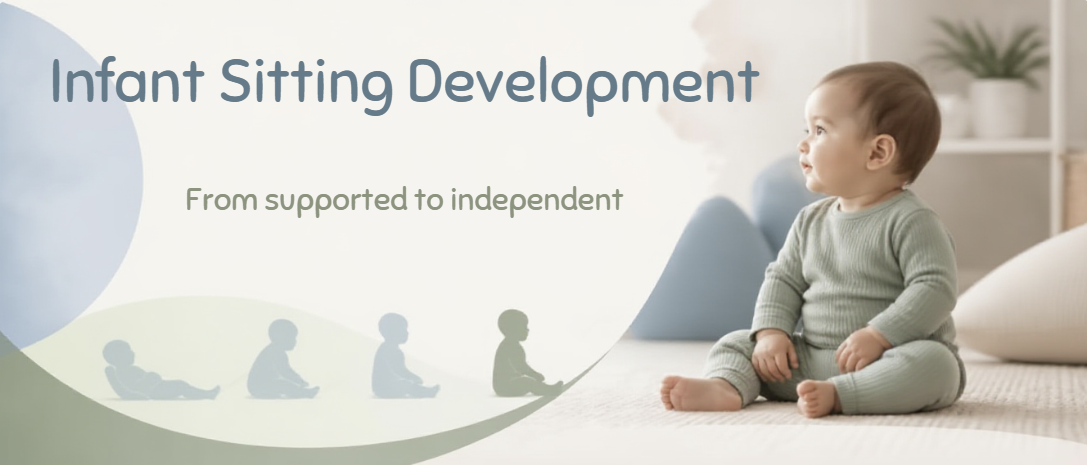
Babies don’t “just sit” one day
Their sitting skills are built on a stack of smaller abilities: head control, trunk control, balance, endurance and the confidence to move in and out of positions safely.
This article breaks down what supported sitting and independent sitting really mean, why sitting matters for play and exploration, what typical stages look like (including tripod sitting), and what to watch for at home—plus when it’s worth getting extra help. It’s meant to be informative, reassuring, and grounded in common developmental patterns.
Supported sitting vs. independent sitting: what’s the difference?
Supported sitting means your baby can stay upright with help—for example, when you hold their trunk, they sit in your lap, or they’re propped with pillows. This can be a useful practice position, but it doesn’t automatically mean they have the balance skills to sit on their own.
Independent sitting (often called “sitting without support”) means your baby can sit on the floor without hands-on help, maintain balance, and recover from small wobbles. As independent sitting develops further, babies also begin learning to get into and out of sitting safely and with increasing control. Toppling is part of learning, but over time they become better able to catch themselves, lower themselves towards the floor and transition between positions.
Key idea: Supported sitting is a practice position. Independent sitting is a balance skill.
Why sitting matters for play, exploration, and balance
Sitting changes your baby’s world. When your baby is upright, their hands are freer to play, reach, bang toys, and explore textures. Their view expands, which supports social interaction, attention, and curiosity.
Sitting also develops your baby’s balance and postural control: your baby learns how their body responds when they lean forward for a toy, turn to look at a sound, or shift weight to one side. Those “tiny wobbles” are valuable practice for future skills like moving on hands and knees, pulling to stand, and cruising along furniture.
The developmental skills underneath sitting
Independent sitting is built on several pieces working together:
Head and neck control — steady head control helps the body organize around a stable “top.”
Trunk strength and endurance — your baby needs to hold their rib cage and pelvis aligned long enough to play, not just for a second or two.
Postural control — the ability to make small adjustments (tightening, relaxing, and shifting) to stay upright without stiffening.
Weight shifting — leaning slightly without collapsing is key for reaching and for later transitions (like moving from sitting to hands-and-knees).
Protective reactions — quick “catch” responses with the arms (and later, controlled lowering) help prevent face-first falls and build confidence to explore.
Tripod sitting: a normal step on the way
Many babies first sit in a tripod position: they lean forward and use one or both hands on the floor for support. Tripod sitting is often an early strategy—your baby is using their arms to widen their base of support while their trunk control is still developing.
As balance improves, you’ll usually see more hands-free play: your baby sits taller, rotates their trunk to look around, and reaches with one arm without immediately tipping over.
Balance and protective reactions (the “catching yourself” part)
Early on, your baby may topple when they lose balance—this is expected. Over time, protective reactions emerge and get stronger: reaching a hand out to the side, forward, or backward to prevent a fall. These reactions are part of typical motor learning and often go hand-in-hand with increased exploration and confidence.
Stages of sitting: emerging → developing → mastering
Every baby’s path is a little different, but sitting often follows a recognizable progression:
Emerging sitting — brief upright moments with support; leaning forward; hands frequently on the floor; quick fatigue. Tripod sitting often shows up here.
Developing sitting — longer independent sitting with occasional wobbles; improved righting (regaining balance); beginning protective reactions; more reaching and turning while seated.
Mastering sitting — hands-free play for longer periods; easy rotation to both sides; reaching in multiple directions; increasingly controlled transitions into and out of sitting, with greater freedom to pivot and move towards other floor positions.
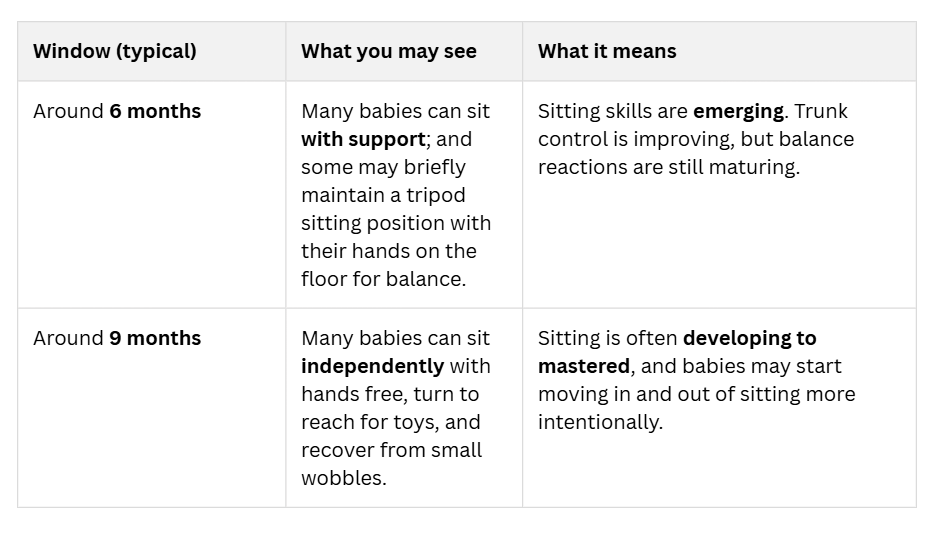
Reminder: “Around 6 months” and “around 9 months” are common milestone windows, not deadlines. A baby can be perfectly healthy while reaching these skills earlier or later.
Posture and asymmetry: what’s worth noticing
When babies are learning to sit, you’ll see lots of experimentation—rounded backs, wide legs, leaning, and frequent hands-down support. That’s normal early on. What you’re watching for over time is variety and symmetry in how your baby uses their body.
Patterns worth keeping and eye on over time includes:
Consistent leaning to one side (always tipping the same way).
Always using one hand to prop while the other plays, without switching sides over time.
Head tilt that persists in sitting (not just a momentary look).
Leg positioning that looks “stuck” (for example, difficulty bringing legs into different positions during floor play).
Baby equipment and walkers: how they can affect sitting practice
Baby seats, loungers, jumpers, and walkers can be convenient, but they should not replace oppertunities for unrestricted floor play. When equipment holds a baby in position, the baby has fewer opportunities to practice the small balance reactions, weight shifts and transitions that develop through self-directed movement.
Mobile baby walkers are different. They are not recommended because they carry a significant injury risk and do not help babies learn to walk.
Practical balance: Use appropriate equipment when it serves a practical purpose, while making regular floor play the main environment for practicing movement.
What to notice at home (simple, helpful observations)
You don’t need special tests—just watch your baby during everyday play. Here’s a home checklist you can use over a week or two:
Can my baby sit with less support than before (for example, hands at hips instead of chest, or briefly hands-free)?
Does my baby switch sides when propping or reaching (not always leaning to the same side)?
Can my baby turn to look at toys on both sides while sitting?
Can my baby reach forward for a toy and come back upright without collapsing?
Do I see attempts to catch themselves with hands when they wobble?
Is floor time part of our daily routine, with space to roll, pivot, or move toward hands-and-knees?
When to seek help (and why it can be a good thing)
It’s reasonable to check in with your pediatrician or appropriately qualified healthcare professional experienced in infant development if you notice any of the following:
Loss of skills (your baby stops doing something they previously could do).
Strong, persistent asymmetry (consistent leaning, one-sided propping, or difficulty turning equally to both sides).
Very stiff or very floppy posture during play (always rigidly arched, or unable to hold the trunk up even briefly).
Little or no progress over time in supported sitting or floor mobility, especially if combined with feeding difficulties or reduced interaction/alertness.
Concerns about head shape or head position (persistent head tilt or preference to look one direction).
Seeking support doesn’t mean something is “wrong.” Often it means you’re getting tailored ideas to help your baby practice skills efficiently and comfortably—especially if posture or asymmetry is getting in the way of exploration.
The bigger developmental picture: sitting prepares the body for what comes next
Sitting is not the final destination—it’s part of a bigger movement story. As sitting becomes more stable, many babies begin to:
Reach farther outside their base of support (leaning, twisting, recovering).
Transition down to the floor more intentionally (instead of toppling).
Explore pivoting, rolling, or pushing up onto hands-and-knees.
These emerging abilities - weight shifting, trunk control, rotation and coordinated movement - are also used during transitions, floor mobility and hands-and-knees movement. Sitting therefore becomes part of a much bigger movement story rather than an isolated milestone.
Sitting is more than a milestone to kick off. What matters is how your baby learns to balance, explore, adapt and move beyond the position as their movement skills continue to develop.
References
Adolph, K. E., & Robinson, S. R. (2015). The road to walking: What learning to walk tells us about development. Current Directions in Psychological Science.
American Academy of Pediatrics. (2022). Motor Delays: Early Identification and Evaluation (Clinical Report).
Centers for Disease Control and Prevention (CDC). (n.d.). Developmental Milestones (movement/physical development guidance).
Piper, M. C., & Darrah, J. (1994). Motor Assessment of the Developing Infant. Philadelphia: Saunders.
World Health Organization (WHO). (2006). WHO Motor Development Study: Windows of achievement for six gross motor development milestones.
Disclaimer: This article provides general developmental information and is not a substitute for an individual assessment, diagnosis, or medical advice. If you have concerns about your baby’s development, consult your pediatric healthcare provider or a qualified pediatric therapist.