Understanding Head Control: When Your Baby Learns To Stabilise Their Head
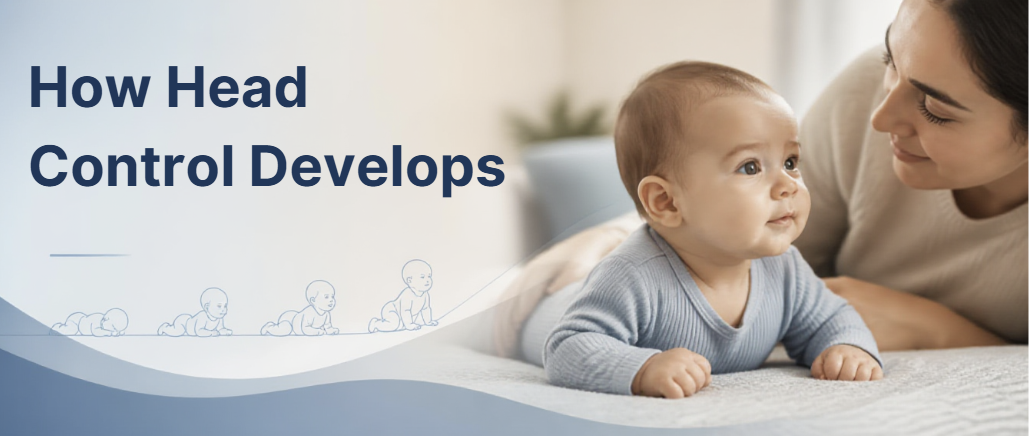
After learning to lift the head against gravity, another important change begins to happen
Your baby starts learning to control the head while the rest of the body moves. This is more complex than simply having “strong neck muscles.”
When you pick your baby up, pull them gently towards sitting, carry them against your shoulder or move them from one position to another, the position of their body changes constantly. The head has to respond to those changes.
At first, it cannot do this reliably — which is why a young baby's head needs support.
Gradually, however, the head begins to move with the body rather than simply falling backwards, forwards or to the side.
Head control is developing.
And once again, it doesn't arrive overnight.
It emerges, develops and is eventually mastered.
What is head control?
Head control is the ability to stabilise and move the head in relation to the body and gravity.
That distinction is important.
A baby who can lift their head during tummy time is beginning to develop antigravity control, but that does not necessarily mean they can maintain the head when their body changes position.
Head control involves continuous small adjustments as the baby’s body and environment changes.
When the body moves backwards, the head needs to respond.
When the body tilts sideways, the head needs to adjust.
When something interesting appears on the other side of the room, the baby needs to turn the head without losing control of the rest of their posture.
Eventually, these adjustments happen almost automatically.
That is when head control starts becoming useful for something much bigger.
Why does head control matter?
Early in life, so much effort goes into simply organising the head and body against gravity. As head control becomes more established, the baby can begin directing attention and movement elsewhere.
They can look towards a parent's face.
Follow movement around the room.
Turn towards a sound.
Watch their own hands.
Reach towards something interesting.
And eventually maintain the head while rolling, sitting and moving through increasingly challenging positions.
This is an important developmental principle:
Control creates freedom.
When the baby no longer has to devote so much effort to controlling the head, movement becomes available for exploration and function.
What is happening underneath?
Head control requires coordination between the developing nervous system, sensory systems and muscles throughout more than just the neck.
The baby receives information about movement and position from the visual system, vestibular system of the inner ear, and sensory information from the muscles, joints and skin. The nervous system continually integrates this information to help organise an appropriate movement response.
At the same time, control through the shoulders and trunk is developing. The head does not function independently from the body beneath it. Increasing head control therefore involves learning to organise the head, neck and trunk together as the baby moves and responds to their environment.
This is one reason development often appears to unfold in layers. Head lifting provides opportunities to develop head control; increasing head and trunk control then supports the increasingly complex movements that follow.
Emerging → Developing → Mastering
Just like head lifting, head control develops gradually.
Emerging
Early head control can be inconsistent.
You may notice your baby briefly keeping the head aligned with the body before it moves forwards, backwards or to the side again.
When supported upright, the head may still wobble considerably.
During movement, your baby may need substantial support around the head and upper body.
This doesn't mean nothing is happening.
Those brief moments of control are the beginning of the skill.
Developing
Over the following weeks, control becomes more consistent.
You may notice:
less head wobbling when your baby is held upright
longer periods with the head centred over the body
improved ability to turn the head while remaining upright
less support needed during handling
increasing control when moving between positions
better head stability during tummy time and supported sitting
As control develops, the baby becomes increasingly able to anticipate and adjust to movement rather simply responding after the body has moved.
Mastering
As head control becomes established, the baby can maintain the head much more reliably while the body moves. By around 4 months, most babies can hold their head steady without support when being held. But mastery means more than simply holding the head still.
The baby should increasingly be able to:
stabilise it, move it, turn it and adjust it.
The head has become a controlled part of a moving body. That creates the foundation for the next developmental challenge.
What about head lag?
Parents sometimes notice that when a young baby is moved from lying towards an upright position, the head initially falls behind the body.
This is commonly called head lag.
Some head lag is expected in young infants because the muscles and postural control needed to keep the head aligned with the trunk are still developing.
Over the first few months, the amount of lag should gradually decrease as control improves.
This makes progression important.
Rather than testing your baby repeatedly to see whether head lag is present, notice how head control is changing naturally during everyday handling.
Is your baby beginning to bring the head forward with the body?
Does the head require less support than it did several weeks ago?
Does control appear more consistent?
Persistent or marked head lag as development progresses - particularly when accompanied by unusual stiffness, floppiness, asymmetry or delayed motor development - deserves further assessment.
Head control is not the same as keeping the head perfectly still
Good control does not mean rigidity.
In fact, the opposite is true.
The goal of postural control is not to freeze the head in one position.
A baby needs to be able to stabilise the head while still being free to move it.
Your baby should gradually become able to look left, right, upwards and back towards the centre while maintaining control.
This ability to move while remaining stable becomes increasingly important as reaching, rolling and sitting develop.
Stability should create movement — not prevent it.
Small things worth noticing
Once again, don't only ask:
“Can my baby hold their head?”
Look at how they are doing it.
Is the head usually centred?
The head does not need to remain perfectly straight all the time.
Babies look around, move and explore.
But over time, you should see increasing ability to bring the head towards the middle rather than a persistent tilt or rotation towards one side.
Can your baby turn both ways?
A strong preference for one direction can influence how the baby moves, uses the arms and distributes pressure across the skull.
If your baby consistently avoids turning one way or the movement appears restricted, it is worth having this assessed.
Does the head repeatedly tilt?
A persistent head tilt is different from occasional uneven positioning.
If the ear repeatedly moves towards the same shoulder or the head consistently appears tilted during different activities and positions, this deserves attention.
Does the body seem to help excessively?
Watch the whole baby rather than only the head.
Does turning the head produce a large movement through the entire body?
Does the baby repeatedly arch backwards to maintain the head?
Does the body consistently curve towards one side?
Early movements can naturally be somewhat uncoordinated, but with development there should be increasing control, variety and independence of movement.
What if my baby seems very stiff?
Parents often describe babies as “strong” when they feel firm during handling or appear able to hold themselves upright early.
But strength and stiffness are not the same thing.
A baby developing good postural control should gradually become capable of both stability and movement.
Persistent stiffness, repeated strong extension or arching, difficulty bending the body, consistently clenched or rigid postures, or limited variety of movement may warrant further assessment — particularly when several of these features occur together.
One observation does not diagnose a neurological problem.
It is the pattern and progression over time that provide useful information.
What about a baby who feels very floppy?
At the opposite end, some babies may feel unusually difficult to support because the head and body seem to “sink” into the person holding them.
Babies naturally vary in muscle tone and posture.
However, persistent difficulty controlling the head together with marked floppiness, reduced spontaneous movement, feeding difficulties or delayed progression through other motor skills should be discussed with a healthcare professional.
Again, the question isn't whether every baby looks identical.
It is whether control is progressively developing.
When should I ask for help?
Consider discussing your baby's head control with an appropriate healthcare professional if:
head control is showing little progression
marked head lag persists as your baby gets older
the head consistently tilts towards one side
your baby strongly prefers looking in one direction
turning towards one side appears restricted
your baby appears persistently unusually stiff or floppy
frequent pronounced arching accompanies other developmental or feeding concerns
movements appear markedly asymmetrical
your baby loses a skill they previously demonstrated
you simply feel that something about your baby's movement does not look right
Parents don't need to diagnose the problem before asking for help.
Recognising a persistent pattern is enough reason to ask a question.
What can you do at home?
Everyday movement provides countless opportunities for your baby to develop head control.
Continue providing supervised tummy time while awake.
Allow your baby opportunities to look towards both sides during feeding, play and interaction.
Change the direction from which you approach your baby or present interesting toys and faces.
During normal handling, allow your baby opportunities to participate in movement rather than keeping the head and body completely fixed — while still providing the support appropriate for their current level of control.
And remember that development doesn't need to be rushed.
The aim isn't to make a young baby sit or stand before they are ready.
It is to provide safe, varied opportunities to experience movement and gradually master control.
From head control to movement
Head control changes what becomes possible.
Once the head can remain organised while the body moves, the baby has greater freedom to look, reach and shift weight.
Soon, something particularly exciting starts happening.
The baby begins discovering that moving the head, shoulders, trunk and pelvis together can change the position of the entire body.
And sometimes — almost by accident at first — they end up somewhere completely different.
They begin to roll.
That will be the next milestone in the Understanding Development series.
References
American Academy for Cerebral Palsy and Developmental Medicine. Early Detection of Cerebral Palsy Care Pathway.
Centers for Disease Control and Prevention. Milestones by 2 Months: Learn the Signs. Act Early.
Centers for Disease Control and Prevention. Milestones by 4 Months: Learn the Signs. Act Early.
Einspieler C, Prechtl HFR. Prechtl's assessment of general movements: a diagnostic tool for the functional assessment of the young nervous system. Mental Retardation and Developmental Disabilities Research Reviews. 2005;11(1):61–67.
Hewitt L, Kerr E, Stanley RM, Okely AD. Tummy Time and Infant Health Outcomes: A Systematic Review. Pediatrics. 2020;145(6):e20192168.
Romeo DM, Cioni M, Scoto M, Mazzone L, Palermo F, Romeo MG. Neuromotor development in infants with cerebral palsy investigated by the Hammersmith Infant Neurological Examination during the first year of age. European Journal of Paediatric Neurology. 2008;12(1):24–31.
This article provides general developmental information and does not replace an individual assessment by your child's healthcare professional.