Understanding Visual Tracking: When Your Baby Begins To Follow The World
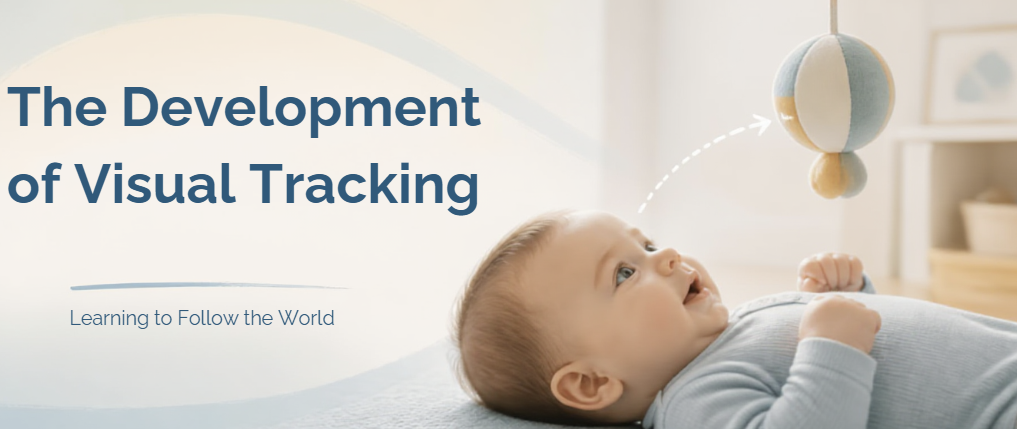
Visual tracking is your baby’s developing ability to fix their gaze on an object and follow it with their eyes as it moves.
It is one of the earliest building blocks for skills such as reaching, hand-eye coordination, visually exploring the environment and following people’s faces and movements.
This article explains when visual tracking typically develops, what you may notice at different ages, how you can support it at home, and when it’s worth checking in with a clinician. The information below reflects common developmental patterns and pediatric vision guidance; individual timelines can vary.
What Visual Tracking Means (and Why It Matters)
In the first months of life, your baby’s visual system is rapidly organizing. Visual tracking depends on several skills working together:
Fixation — holding the gaze on a face or object long enough to “lock on.”
Smooth pursuit — following a moving target with steady eye movements (instead of quick jumps).
Eye teaming — using both eyes together so images line up and feel stable.
Attention — staying interested in a target long enough to track it.
When Babies Typically Start Tracking
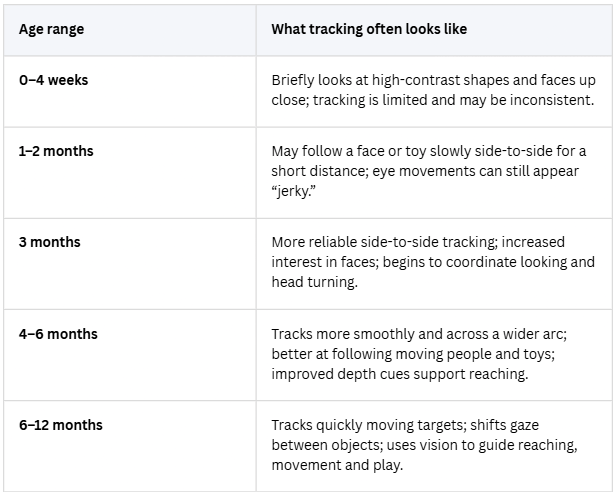
Development is gradual. Babies usually show early interest in faces first, then become better at following objects over time.
Key idea
Tracking is not a single “switch.” Many babies show early, inconsistent tracking before it becomes smooth and reliable over the next several months.
Signs Your Baby Is Practicing Visual Tracking
You may notice these everyday behaviors as your baby’s tracking improves:
Face focus — watching your eyes and mouth when you talk or smile.
Following movement — looking after a caregiver walking across the room.
Looking then reaching — staring at a toy and attempting to bring hands toward it (often around the middle of the first year, with lots of practice along the way).
Gaze shifts — looking from one object to another, especially during play and feeding.
How to Encourage Healthy Visual Tracking (Simple, Calm Activities)
These activities are gentle, age-appropriate ways to invite tracking—without overstimulating your baby.
Use face-to-face time — hold your baby so your face is comfortably close and let them study your features while you speak slowly.
Try slow side-to-side movement — move a high-contrast toy or your face slowly from left to right, pausing in the middle so your baby can re-fixate.
Keep it short — a few calm repetitions are enough; stop when your baby looks away or fusses (looking away is a normal “break” cue).
Use good lighting — soft daylight or evenly lit rooms help babies see details without glare.
Offer variety — alternate between faces, simple patterns, and safe toys with clear edges; as your baby grows, add gentle up-and-down tracking and closer/farther viewing.
Tip
Move targets slowly. If something moves too fast, babies often stop tracking—not because something is wrong, but because the task is too difficult at that stage of development.
When to Talk With Your Pediatrician (or an Eye Specialist)
Many variations are normal, especially in the early weeks. Consider discussing vision and tracking with your baby’s clinician if you notice any of the following patterns (particularly if they persist over time):
Little or no visual fixation on faces or objects by around 8–12 weeks.
Not tracking a slow-moving object side-to-side by about 3 months.
Eyes that appear constantly misaligned (one eye consistently turning in or out), especially after 3–4 months.
Repeated involuntary or rhythmic eye movements (nystagmus).
Strong light sensitivity, persistent tearing, or cloudiness in the pupil/cornea.
A clear difference between the eyes (one eye seems to track while the other does not).
If you are unsure, it is appropriate to bring it up at a well-child visit. Early evaluation can be reassuring when everything is on track—and helpful when support is needed.
References
American Academy of Pediatrics (AAP) — vision screening and child development resources
American Academy of Ophthalmology (AAO) — pediatric eye health information
Centers for Disease Control and Prevention (CDC) — developmental milestones
National Eye Institute (NEI) — vision and eye health education
This article is for general educational purposes only and is not a substitute for medical advice, diagnosis, or treatment. If you have concerns about your baby’s vision, eye alignment, or overall development, contact your pediatrician or a qualified eye care professional for personalized guidance.