Understanding Rolling: When Movement Begins To Change Where Your Baby Can Go
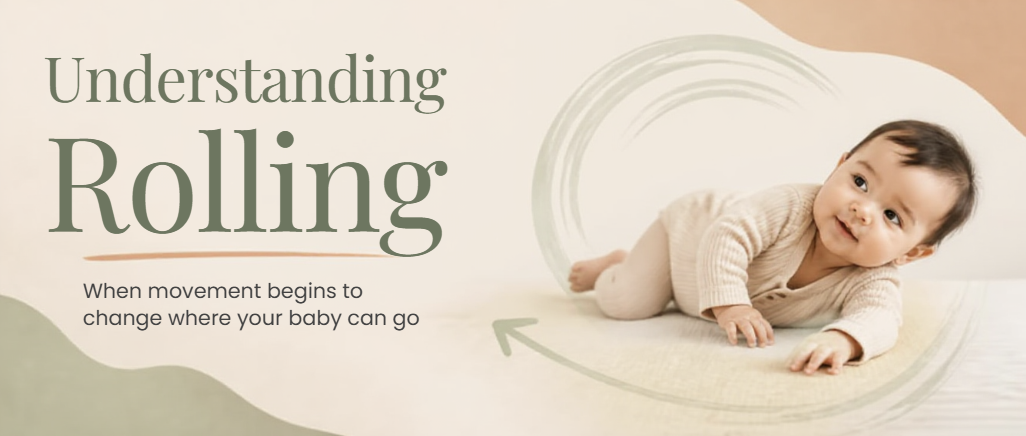
The first time a baby rolls over can be surprisingly exciting
One moment they are lying on their tummy or back — and suddenly they are somewhere else.
But rolling is more than getting from one position to another.
It represents an important change in development.
Your baby is beginning to combine head control, weight shifting, rotation and movement through the trunk to change their position independently.
And, like the milestones before it, rolling isn't simply something a baby either “can” or “can't” do.
It emerges. It develops. And eventually, it is mastered.
Why is rolling important?
Before rolling, much of a baby's world depends on where somebody else places them.
On the back.
On the tummy.
Facing towards a toy.
Facing towards you.
Rolling begins to change that.
For the first time, the baby discovers that their own movement can significantly change their position and therefore what they can see, reach and explore.
This makes rolling an early form of independent mobility.
It also introduces something that will become increasingly important throughout development:
rotation.
The head turns.
The shoulders begin to follow.
The trunk rotates.
The pelvis and legs participate.
Eventually these different parts of the body become increasingly coordinated.
This rotational control will later contribute to reaching, moving in and out of sitting, crawling, standing and walking.
What needs to happen before a baby can roll?
Rolling does not develop in isolation. Many of the skills your baby has been practising during the previous months are beginning to come together.
The baby needs increasing control of the head.
They need opportunities to move both on their back and tummy.
They begin bringing their hands towards the middle.
They discover their legs and feet.
They start reaching.
They become better at shifting their weight.
And increasingly, the two sides of the body begin working both together while also developing more independent movement.
This is why development is better understood as a sequence of connected skills rather than a collection of separate milestones.
One movement creates opportunities for the next.
Not every first roll is intentional
A baby's first roll from tummy to back can sometimes surprise everyone — including the baby.
Young babies have relatively large heads and are still developing postural control. During tummy time, lifting or turning the head can shift their weight enough for them to lose balance and tip onto their back.
Sometimes this is enough for the baby to lose balance and tip onto the back.
They have technically rolled.
But they may not yet have developed controlled rolling.
That distinction matters.
With development, rolling becomes increasingly purposeful, controlled and repeatable.
The baby begins to initiate the movement rather than simply falling into it.
Emerging → Developing → Mastering
Emerging
Early rolling may be inconsistent.
Your baby may:
accidentally tip from tummy to back
begin rolling onto the side but not complete the movement
use the head or legs to initiate large movements
occasionally roll in one direction but not the other
appear surprised when a roll happens
These early experiences are part of learning.
Your baby is beginning to discover that shifting weight can change their position.
Developing
As rolling develops, movement becomes more purposeful.
You may notice your baby:
reaching across the body towards a toy
bringing the legs upwards and across
deliberately rolling onto the side
turning the head towards something interesting
allowing the shoulders and pelvis to rotate
beginning to roll between the back and tummy
repeating the movement more reliably
Rolling is becoming something your baby can choose to do.
Mastering
Eventually, rolling becomes an efficient way to move between positions.
Your baby can increasingly roll:
from back to tummy
from tummy to back
towards either side
with less effort
with better control of the arms and legs
Importantly, the baby begins to control not only getting into the roll, but also arriving in the new position.
The movement becomes smoother and increasingly adaptable.
The roll is no longer simply an event. It has become a movement strategy.
When does rolling happen?
There is considerable normal variation in when babies begin rolling.
The CDC includes rolling from tummy to back as a 6 months movement milestone - a skill most babies are expected to demonstrate by this age.
Many babies begin experimenting with rolling earlier than this, and the direction in which rolling first appears can vary.
This is why one exact rolling age is not particularly useful on its own.
Instead, look at the broader developmental picture.
Is your baby becoming more active?
Are they reaching and turning?
Are they beginning to shift their weight?
Are they exploring side-lying?
Is movement becoming more purposeful?
Once again:
progression matters.
Rolling is not supposed to look identical every time
Babies are learning. Their early movement is naturally variable.
One roll may begin with the head.
Another may begin with the legs.
Sometimes the shoulders move first.
Sometimes the pelvis follows later.
This variability gives the developing nervous system opportunities to discover different ways of solving the same movement problem.
Over time, those movements generally become more coordinated and efficient.
So the goal isn't a perfectly performed textbook roll.
The useful question is whether your baby is developing an increasingly varied and adaptable movement repertoire.
Does a baby need to roll both ways?
Babies frequently develop a preferred direction when they first learn a new skill.
Rolling towards one side before the other therefore isn't automatically concerning.
What we want to see over time is increasing opportunity and ability to move towards both sides.
A baby who occasionally prefers one direction is very different from a baby who appears unable or consistently unwilling to move towards the other.
Persistent one-sided rolling becomes more meaningful when it occurs alongside other asymmetries, such as:
always looking towards the same side
a persistent head tilt
using one arm differently
reaching predominantly with one hand
consistently curving the body towards one side
difficulty turning the head in one direction
Again, we are looking for patterns, not isolated movements.
What does reaching have to do with rolling?
Quite a lot.
Imagine your baby lying on their back and noticing a toy slightly to the side.
First, the eyes move towards it.
Then the head turns.
An arm reaches across the body.
The shoulder begins to rotate.
The trunk follows.
The pelvis shifts.
Suddenly the baby is lying on their side.
With a little more movement, they may continue all the way onto their tummy.
The baby's desire to see, touch and explore has created a reason to move.
This is an important part of motor development.
Babies don't develop movement simply for the sake of performing milestones.
Movement develops because it allows them to interact with their world.
Why is side-lying important?
Between lying flat on the back and rolling onto the tummy is an easily overlooked position:
the side.
Side-lying gives babies opportunities to bring their hands together, reach across the body and experience the effects of gravity from a different direction.
It also provides a natural transition between lying on the back and lying on the tummy.
As rolling develops, babies often spend increasing amounts of time playing on their side before completing the movement.
That little pause on the side is not necessarily failure to roll.
It can be part of learning how to control the movement.
“My baby rolls onto their tummy and gets stuck”
This is very common when rolling first develops.
A baby may discover how to roll from the back onto the tummy before becoming equally skilled at getting back again.
Suddenly they have gained enough mobility to get themselves into a position they cannot yet easily leave.
This can be frustrating — particularly at night.
During awake play, continue giving your baby opportunities to practise moving in both directions rather than always immediately repositioning them.
With experience, the missing movement usually begins to develop.
Rolling and safe sleep
Once babies begin rolling, sleep often becomes a source of anxiety for parents.
Continue placing your baby on their back at the beginning of every sleep, on a firm, flat sleep surface without loose bedding, pillows, positioners or soft objects.
Once a baby can independently roll into another position, parents should not use devices to hold the baby in one sleep position.
Swaddling also needs particular attention as rolling approaches. A baby who is showing signs of attempting to roll should no longer be swaddled with the arms restricted.
Safe sleep recommendations remain important even as your baby's mobility changes.
Small things worth noticing
Rather than only asking:
“Is my baby rolling yet?”
notice what is happening around the movement.
Is your baby exploring both sides?
A temporary preference can be normal.
A persistent inability to move towards one side deserves more attention.
Are both arms participating?
Watch whether your baby reaches with both hands and whether either arm repeatedly becomes trapped beneath the body during rolling.
Is rotation developing?
Does the body gradually begin rotating through the movement, or does your baby consistently move as one very stiff unit?
Early movements can certainly look awkward.
What matters is whether movement becomes more varied and adaptable with experience.
Is your baby progressing?
Perhaps your baby isn't completing a roll yet.
But are they:
reaching across the body?
bringing their feet upwards?
turning onto the side?
rotating through the trunk?
shifting their weight?
becoming increasingly active on the floor?
These are all pieces of the developing skill.
When is it worth asking for help?
Consider discussing your baby's development with an appropriate healthcare professional if:
rolling or attempts to roll show little progression
your baby consistently moves only towards one side
movement towards the other side appears difficult or restricted
one arm or leg is consistently used differently from the other
your baby has a persistent head tilt or strong head-turning preference
your baby appears persistently unusually stiff or floppy
your baby shows very little spontaneous movement or exploration
movement patterns remain markedly asymmetrical
your baby loses a skill they previously demonstrated
you have concerns about their overall development
A baby does not need to demonstrate a perfect roll.
We are looking for development, exploration and increasing movement possibilities.
What can you do at home?
Floor time is one of the simplest ways to give your baby opportunities to discover rolling.
Allow supervised awake play in different positions — on the back, tummy and side.
Place interesting toys or your face slightly to the side rather than always directly in front of your baby.
Give them opportunities to reach across the body.
And when they begin attempting a movement, sometimes give them a moment to work out what comes next rather than immediately completing it for them.
The aim isn't to repeatedly “teach” your baby a perfect roll.
It is to create safe opportunities to explore movement and solve movement problems.
The bigger picture
Rolling represents an important change.
Until now, much of your baby's early development has focused on gaining control against gravity.
Now they are beginning to use that control to change position.
They are learning to shift weight.
To rotate.
To move one part of the body in relation to another.
And most importantly, to use movement to get somewhere they want to go.
Soon, however, your baby will face an entirely different challenge.
Instead of controlling the body while lying against a surface, they will begin trying to organise the head and trunk upright against gravity.
They will begin learning to sit.
That will be the next milestone in the Understanding Development series.
References
Centers for Disease Control and Prevention. Milestones by 6 Months: Learn the Signs. Act Early.
Einspieler C, Prechtl HFR. Prechtl's assessment of general movements: a diagnostic tool for the functional assessment of the young nervous system. Mental Retardation and Developmental Disabilities Research Reviews. 2005;11(1):61–67.
Hewitt L, Kerr E, Stanley RM, Okely AD. Tummy Time and Infant Health Outcomes: A Systematic Review. Pediatrics. 2020;145(6):e20192168.
Moon RY, Carlin RF, Hand I; American Academy of Pediatrics Task Force on Sudden Infant Death Syndrome. Sleep-Related Infant Deaths: Updated 2022 Recommendations for Reducing Infant Deaths in the Sleep Environment. Pediatrics. 2022;150(1):e2022057990.
World Health Organization Multicentre Growth Reference Study Group. WHO Motor Development Study: windows of achievement for six gross motor development milestones. Acta Paediatrica Supplement. 2006;450:86–95.
This article provides general developmental information and does not replace an individual assessment by your child's healthcare professional.